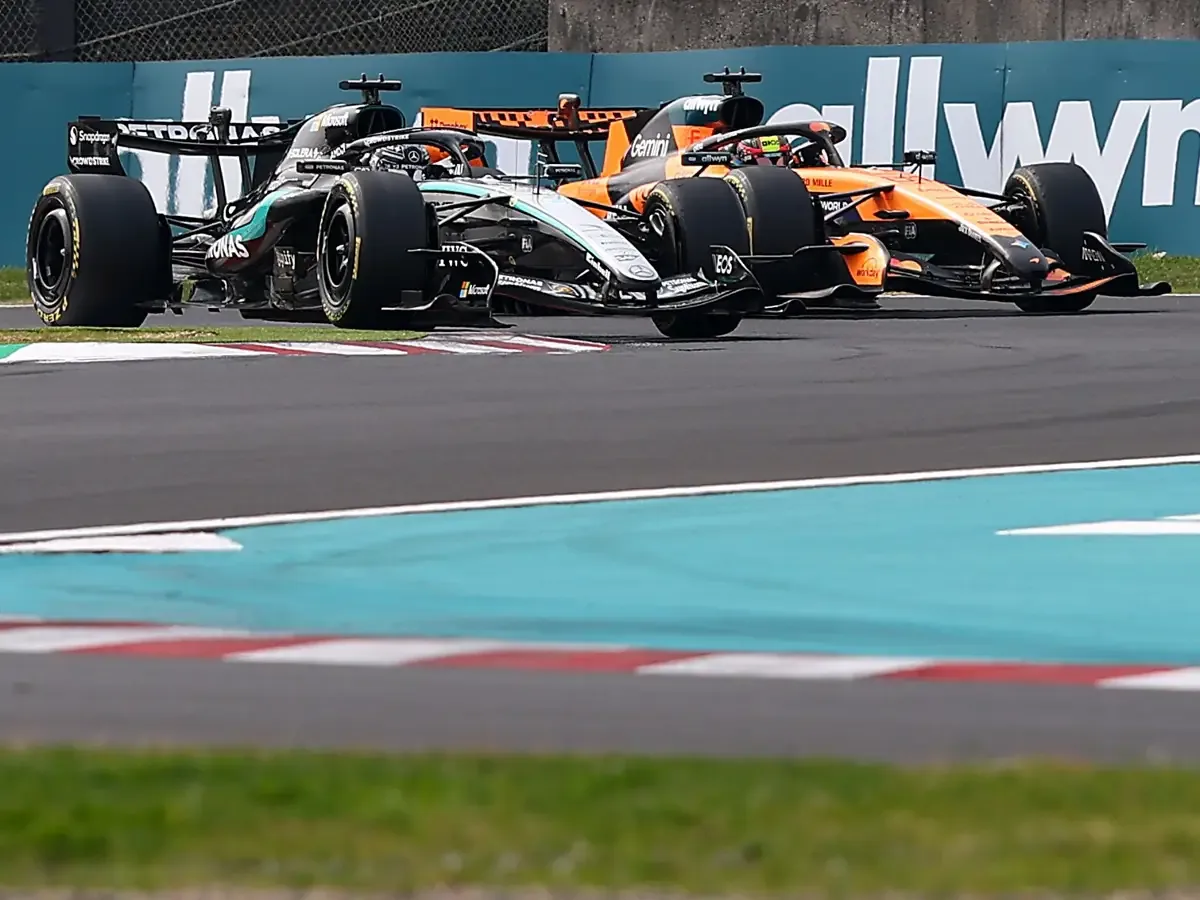
(Motorsport-Total.com) – George Russell believes that Mercedes’ current advantage in Formula 1 is “only fair”. But Mercedes remains vigilant to avoid a repeat of the last major rule change in Formula 1, when Ferrari, an early frontrunner, was later overtaken. But how sustainable is this comparison?
Read more Williams: James Vowles sends clear message after difficult start
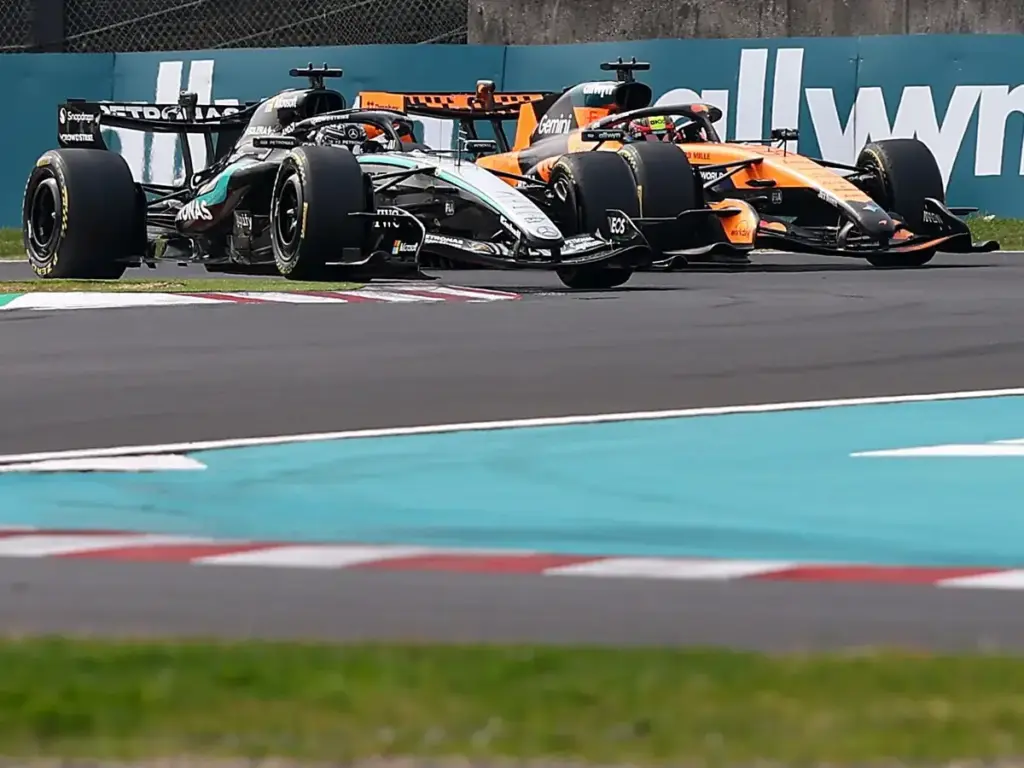
Although Russell had some bad luck, Mercedes, after three race weekends, is unsurprisingly at maximum output: three wins in three Grands Prix. Even though a one-two finish was not achieved in Japan because Russell fell victim to the Safety Car timing, Mercedes has fully confirmed its role as favorite, which had already been attributed to the team during testing in Bahrain.
Part of this is, of course, due to the chassis and the aerodynamic platform, but Russell admits that the initial advantage is also due to a better understanding of their own power unit and optimized energy management.
“I think we definitely started strong in the first three races, and you’ve seen with all engine manufacturers – or at least with us and Ferrari – that as a works team, we have a better understanding of energy management than the customer teams,” said Russell.
The current number two in the championship standings adds that he considers this initial advantage fair because an enormous amount of work has gone into it behind the scenes and works teams often benefit from regulation changes.
“That’s only fair because hundreds of people are working on it, and we’ve been working on it in the simulator for three years,” he explains. However, Russell also knows that this advantage is not unlimited. McLaren already made a big step in Japan in understanding the power unit and optimizing energy management.
After dissatisfaction at the season opener in Melbourne, significant progress has been made together with Mercedes HPP, as Team Principal Andrea Stella explains: “I can confirm that we have made a big step compared to Australia, both in our collaboration with HPP and in the joint development of simulation tools.”
“So I think we as a team are now much better prepared,” says Stella, who emphasizes: “At the start of the season, there may have been a deficit, as a natural consequence of being a customer team and the programming being pushed so hard, also from the perspective of the power unit.”
“That was fine, and we were prepared to accept that, and we worked through it very constructively with HPP. But later in the season, I believe we have closed that gap, and we should now have all the tools to get the maximum out of the power unit,” says Stella.
Is Mercedes’ lead bigger than it looks?
Russell is therefore aware that the development rate will be crucial throughout the year. Nevertheless, he does not believe that Mercedes’ advantage will simply disappear overnight, which is why the team can still be considered a clear favorite for Miami.
“Of course, these big differences we saw in Melbourne have, in my opinion, already become smaller, and everyone will gain a better understanding from race to race,” explains Russell.
“So I think the field will slowly close up, but I don’t expect to suddenly see drastic changes [in Miami]. However, I also don’t believe that our big pace advantage will last indefinitely. The others will be hot on our heels.”
That’s a realistic assessment. The “yo-yo racing” in the first race weekends obscured part of it, but as soon as Mercedes was able to pull away, the pure pace advantage remained clearly noticeable.
Tears instead of Titles: Eight Fallen Formula 1 Greats
In Australia and China, both races followed a similar pattern: after Ferrari’s strong start, there was close yo-yo racing, but Mercedes exploited its pure pace advantage as soon as it had clear track.
After the Japanese Grand Prix, Russell suggested that Oscar Piastri would have been a serious opponent without the Safety Car. While there is certainly a grain of truth in that, teammate Kimi Antonelli nevertheless pulled away from the Australian by 14 seconds afterwards.
This shows that Mercedes’ advantage is considerable and at times even greater than it seemed. The data also confirms this and makes it plausible that this lead will not simply disappear.
Why Russell compares the situation to 2022
Russell nevertheless remains cautious about what he calls the “2022 scenario”: the situation in which the team leading after the first races under new rules is caught up by the competition later in the season. This happened to Ferrari in 2022 compared to Red Bull.
“I hope that only the two of us will fight for the championship, but I don’t want to think too far ahead, because I’ve said this many times: in 2022, Leclerc had, I believe, over 30 points lead after three races, and Verstappen said the championship was over. Ferrari was the fastest team, and in the end, they weren’t anymore,” Russell recalls.
Russell is right that the first year under new regulations is always an enormous development battle and the pecking order can change significantly. Nevertheless, there are important differences to Ferrari’s situation in 2022.
Read more Jeff Dodds is convinced: Formula E helps Formula 1 understand new rules
Formula 1 Quiz
What is the Mercedes team’s win rate in Formula 1?
Test yourself now in the Formula 1 quiz and compare yourself with other users
Ferrari and Red Bull were already on par in the first race back then, which differs significantly from the current situation. Just think of the entertaining duel between Charles Leclerc and Max Verstappen in Bahrain.
Red Bull simply had two retirements in the Middle East, followed by another setback for Verstappen in Australia. In the points standings, Red Bull therefore looked worse than it actually was.
In addition, the Red Bull back then – as is also the case today – was significantly overweight, so much lap time could be gained by reducing weight. The advantage Mercedes now has is greater than Ferrari’s lead at the start of the 2022 season and built on different foundations. Therefore, the comparison does not fully hold.
Development Battle: Which Platform Has the Most Potential?
For the rest of the season, two variables are particularly crucial: ADUO and the development battle, whose next and very interesting chapter will be Miami. Andrea Stella has indicated that McLaren will travel to sunny Florida with an almost completely new package.
However, he expects all other teams to proceed similarly. McLaren had already scheduled Miami as the date for the first major update, regardless of calendar changes, and this strategy has proven successful in recent years.
Ultimately, apart from the power unit, it’s about which platform still has the greatest development potential. This is indeed a parallel to 2022, because back then, at the beginning of the new era, three very different sidepod philosophies were seen: Downwash (Red Bull), Inwash (Ferrari), and Zero-Pod (Mercedes).
Ferrari admitted that the Red Bull concept had more development potential than their own approach, after which a convergence of concepts took place. So far, 2026 – as Piastri also explained – is primarily about the power unit and energy management.
However, this does not diminish the fact that the development of the chassis and aerodynamics is likely to become crucial in the future, especially since the understanding of the power unit will no longer determine performance as strongly later on.
At Mercedes, the first signals for this development battle are positive, explains Russell: “I think we have a very good direction. I think the correlation is very good. We are ticking all the boxes that tell us we have a really strong base with the car, but of course, these things change.”
McLaren had an advantage over all other teams in terms of development in recent years, but that is no guarantee under these new regulations. Therefore, it is crucial to see which platform offers the greatest development potential – not only this year, but also in the coming seasons.
Why ADUO is a politically sensitive topic
The last important factor is ADUO, the safety net in the engine regulations. The original idea was that the pure performance of the internal combustion engine would be measured every six races, and manufacturers lagging between two and four percent would receive an additional upgrade opportunity. Manufacturers lagging more than four percent would get two upgrades.
Due to the situation in the Middle East, the FIA must now decide on the exact timing and, logically, who is eligible for ADUO at all. Ferrari team principal Frederic Vasseur had already indicated that ADUO would offer the Scuderia a good chance to make progress on the power unit side.
But Wolff emphasized that the rule was not intended for that. “The principle of ADUO was to help teams that are behind on the power unit side so they can catch up – but not to overtake others,” said the Mercedes team principal.
“Of course, the teams have their own pictures of performance. But as it looks to me, there is one engine manufacturer with a problem that we need to help. All others are pretty much in the same range.”
“I would be very surprised and disappointed if ADUO decisions led to interventions in the current competitive order,” said Wolff. He thus made it clear that, in his view, Honda is the only manufacturer that truly needs ADUO.
There are also other complicating factors. Ferrari, for example, has made certain strategic decisions, including the use of a smaller turbo. This brings advantages at the start of the season but could affect performance. Does that justify ADUO? This shows that this year’s development battle, at least on the power unit side, also has a strong political component.
In summary, it is understandable that Mercedes is not celebrating too early and keeps in mind what happened four years ago. Russell is therefore right that Mercedes must be cautious in the first year of new regulations regarding a shifting competitive order – especially given McLaren’s development history in recent years.
But the comparison with 2022 does not fully hold at the moment. After all, Mercedes has a different and significantly larger lead than Ferrari did against Red Bull back then.
Read more Helmut Marko: How Red Bull changed after Dietrich Mateschitz