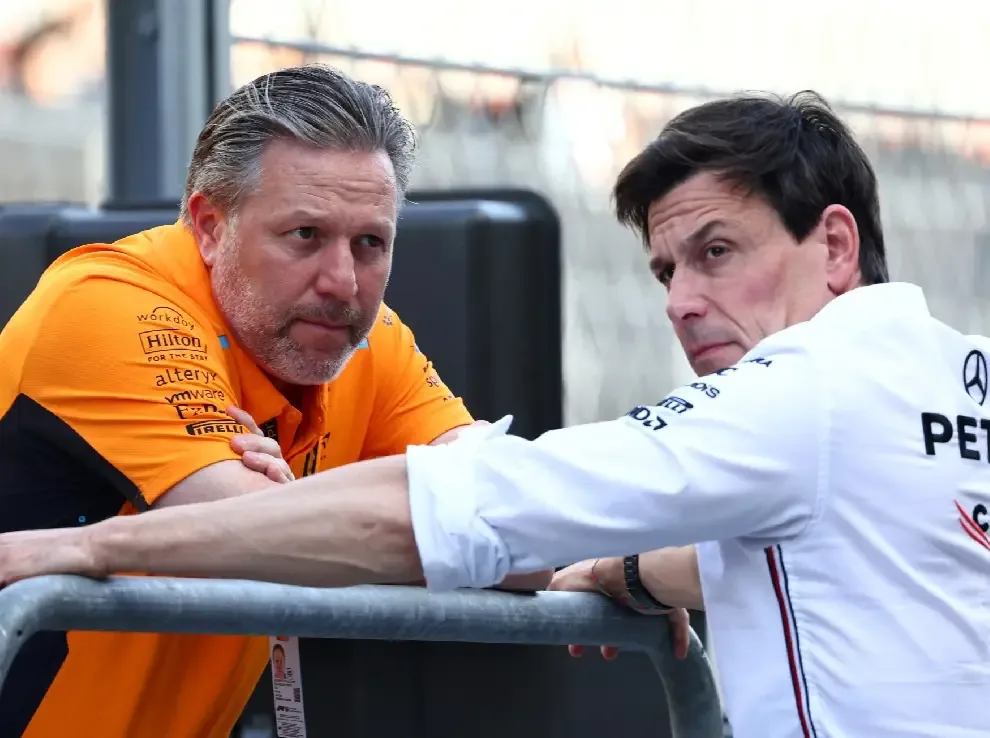
(Motorsport-Total.com) – It’s a particularly hackneyed cliché that a week is a long time in politics. In the goldfish bowl world of Formula 1 politics, two years already seem almost like a completely bygone era.
Read more Argentina hype: Colapinto attracts 600,000 fans to Buenos Aires
How else can it be explained that McLaren boss Zak Brown is currently raising the question of “B-teams” in Formula 1 again, while seemingly setting aside his long-standing objections to Red Bull’s ownership of two teams?
“As far as I know, no other sport allows co-ownership of two teams competing against each other,” Brown said during a press conference at the second winter test in Bahrain in 2024 – more than two years ago.
“So I think the sport – now in the budget cap era – has evolved to where we want ten [now eleven] independent teams, from a sporting, political and technical perspective. I think they [Red Bull] adhere very much to the rules,” Brown said.
“I have a problem with the rules, and I believe the FIA needs to address that,” he said at the time. But today is today, and at a media round last week at the McLaren factory in Woking, the mood sounded subtly different.
Not massively, because Brown explicitly emphasized that his fundamental stance had not changed – but it seemed like a new variation on a familiar theme, with a few additional notes.
The result: Even if he didn’t name Mercedes or Alpine, he is prepared to accept the Red Bull situation (albeit under constant observation), while new alliances, on the other hand, would be a “mistake.”
This is a clear allusion to Mercedes’ interest in acquiring the 24 percent stake in Alpine currently held by Otro Capital. This is his investment company, which is supported by actors Michael B. Jordan and Ryan Reynolds, among others.
Brown specifically warns against this
“It hasn’t changed at all,” Brown emphasizes when asked about his stance on team alliances. “I believe I’ve always been consistent. This is now my ninth or tenth season [as McLaren CEO],” he clarifies.
“I think we need to get away from A-B teams as quickly as possible. Co-ownership – which we currently see in one group and where I understand how and why it came about – is not allowed in almost all major sports today.”
“I think it carries a high risk of compromising sporting integrity. And that leads back to the question: What would deter fans? If they don’t feel there are eleven independent teams,” Brown said.
“I’ve made that clear from the start. We’ve seen it on track: Daniel Ricciardo took the fastest lap point from us to help the other team [Red Bull],” he alludes to a situation at the 2024 Singapore Grand Prix.
And he gives further examples: “We saw IP infringements with the Racing Point brake ducts [2020]. We’ve seen staff changes overnight, while we have to wait or make financial deals, which burdens us in the budget cap.”
“That’s an unfair financial advantage, an unfair sporting advantage. We’ve seen Ferrari and Haas move personnel back and forth. We know a lot of intellectual property is in people’s heads.”
“Imagine a Premier League football match with two teams owned by the same group: one gets relegated if it loses. The other can afford a defeat. That’s exactly the risk we’re taking,” Brown warns.
“I think engine suppliers should be the maximum. And then all eleven teams should be as independent as possible, because otherwise there’s a high risk – and we’ve seen it – that the integrity of the sport suffers. And that would deter fans faster than anything else.”
Red Bull situation must be “controlled and monitored”
It was a fascinating final word. Not only because of what was said, but also because of what was not said. It didn’t necessarily seem rehearsed, but not entirely spontaneous either. Rather, it seemed like a deliberate attempt to throw out a bait.
Read more McLaren: F1 discusses future engine hardware changes
Which, of course, worked, as another rhetorical flourish about Red Bull followed, before Brown again alluded to the actual point of contention. “That was a big topic in the last Concorde Agreement,” Brown said.
“I wrote to the FIA and Formula 1 about it last year because we constantly see and report things. I think there’s more attention and scrutiny from the FIA now.”
“I’m honestly happy to see that Racing Bulls and Red Bull don’t look like the same car. I also spoke to Laurent [Mekies] about it. I don’t want to single him out, but he’s the only one with two teams. And he was very open: ‘If you don’t like something, let’s talk about it.'”
“I think they recognize that and don’t want to cross the line. In the Concorde Agreement, there were discussions about whether one of the teams should be sold in the long term,” Brown reveals.
“But I also have great respect for what they’ve done for the sport and how that came about at the time. So as long as it’s controlled and monitored – but expanding it further, in my opinion, would be a mistake,” he emphasizes.
When asked if this last point referred to Mercedes and Alpine, he replied: “That applies to everyone. A-B teams, co-ownership – no matter who. I don’t think that’s healthy for the sport. It’s nothing personal against a team or a person.”
Who will snatch up the Alpine shares?
Diplomatic subtleties also play a role here, as McLaren had previously wanted to distance itself from accusations that Mercedes had not fully passed on performance data of its new powertrain to customer teams.
Even if Brown emphasizes it’s nothing personal: Mercedes is clearly at the heart of this debate, as it is currently the only company seeking a stake in another team.
So how likely is it that such an entry will bring real influence? Mercedes emphasizes that it is a purely financial investment – and by the company itself, not personally by co-owner and team principal Toto Wolff.
It wouldn’t be a majority stake, but that could change if Renault sells further shares. Some claim Mercedes intervened primarily to block Christian Horner’s attempt to secure the shares. If that’s true, it would be a remarkably petty power move – but not impossible.
Nevertheless, there is concern in the paddock that Alpine could become a partner or customer team of Mercedes. And there are good reasons to prevent that – even beyond the examples mentioned by Brown.
Formula 1 Quiz
What was the best rank of the McLaren team in a Formula 1 race?
Test yourself now in the Formula 1 quiz and compare yourself with other users
For example, Norberto Fontana, Sauber driver in 1997, claimed years later that he had been instructed to hold up Williams driver Jacques Villeneuve to help Ferrari’s Michael Schumacher in the Jerez title decider. Ferrari was Sauber’s engine supplier at the time.
In the mid-2000s, Red Bull bought Jaguar Racing and Minardi within a year, saving both from collapse. Jaguar was symbolically taken over for one pound, including debts.
Dietrich Mateschitz’s plan was to use the former Minardi team as a junior academy and operate it as cheaply as possible – partly by buying chassis from the main team instead of developing their own. This led to protests from competitors and forced rule adjustments, including formally separate development structures.
Later, so-called “customer teams” were banned, and Red Bull’s second team had to design its car independently. But before that, for many rivals: If you can’t beat them, join them.
In 2007, the FIA published an entry list for 2008, confirming Prodrive as a new team. The project failed, but the plan was to source engines and chassis from other manufacturers.
Read more Jean Todt reveals how he convinced Schumacher of the Ferrari switch
From whom? Mercedes and … McLaren.