(Motorsport-Total.com) – An Italian fashion house is becoming the title sponsor of a Formula 1 team. No, we are not writing the year 1983, but 2026. The fashion brand is not Benetton, but Gucci, and the sponsored team is not Tyrrell, but Alpine.
Read more Mattia Binotto confident: Audi perhaps has the fourth best chassis

Nevertheless, it is hard not to bring up the old saying “history repeats itself.” Forty years ago, Benetton entered Formula 1 through sponsorship deals with Tyrrell and Alfa Romeo before the company eventually bought Toleman and turned it into a world championship operation based in Enstone.
Today, it is by no means far-fetched to wonder if Gucci might harbor similar ambitions – especially since the team the brand is now associated with still operates exactly in that factory in the English countryside.
Renault has effectively turned off the money tap for the Alpine Formula 1 team after ending its own engine program. It is expected that part, if not the entire team, currently controlled by Otro Capital, will eventually be sold to an external investor.
Mercedes has already been mentioned as a potential buyer, while Christian Horner is also said to be exploring options with an investor group. But why should Gucci limit itself to naming rights? Forty years ago, Benetton showed how it could be done – with none other than Flavio Briatore in a key role.
United Colors of …
To understand the parallels, it is worth looking back. The story of the Italian clothing giant Benetton did not begin in Formula 1. The company was founded in 1965 by the Benetton family.
The brothers Luciano, Carlo, and Gilberto, along with their sister Giuliana, conquered Europe in the late 1970s with colorful clothing that stood in strong contrast to the rather dull fashion prevailing at the time.
When the company wanted to expand into the USA, Luciano Benetton turned to a young entrepreneur named Flavio Briatore at the end of 1979.
Briatore was only 28 years old but had already experienced numerous business ventures and setbacks. Luciano nevertheless recognized potential in the charismatic young Italian. Both came from rural backgrounds and shared a dislike for the conventions of conservative Italian society.
Briatore got started and opened Benetton’s first store on Madison Avenue in New York in 1980. Less than five years later, the company had 400 stores in the United States, peaking at almost 800.
Benetton became known for its rebellious, provocative, and disruptive attitude – qualities that today might remind some of Red Bull. The company combined a keen sense of fashion trends with advertising campaigns that, under the famous slogan “United Colors of …”, focused on diversity and anti-racism.
These campaigns challenged the establishment and struck a chord with younger generations.
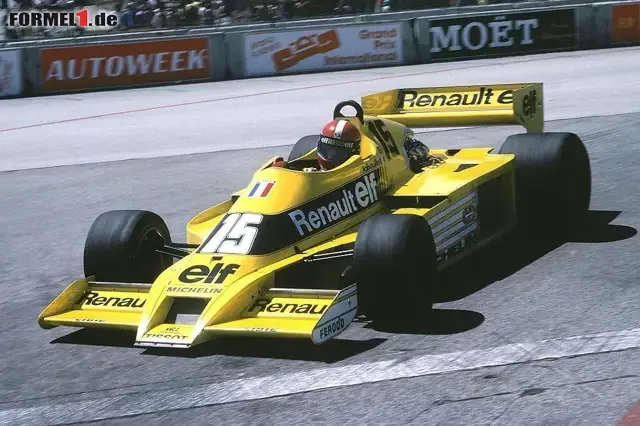
All Formula 1 cars from Renault/Alpine
To strengthen this image, Benetton entered Formula 1. Interestingly, however, this was not Briatore’s idea. At the time, he was dealing with legal problems in Italy and was fully focused on expanding Benetton’s US business.
The initiative instead came from Nanni Galli, a former racing driver who had briefly raced in Formula 1 before joining his family’s textile company. The Galli family supplied Benetton with clothing, and Nanni introduced Luciano Benetton to the world of motorsport.
For Benetton, Formula 1 was a strong marketing tool for the US market. Although the USA’s relationship with the premier class was often changeable, the series experienced a phase of great interest in the early 1980s, with one, two, and at times even three Grands Prix on the calendar. An ideal platform to reach American consumers.
Team Sponsorship
Luciano Benetton attended the 1982 Las Vegas Grand Prix and received the tip to sponsor Tyrrell. The team had just won the race with Michele Alboreto, employed the US driver Danny Sullivan, and seemed a perfect fit.
Read more How Liam Lawson and Franco Colapinto saved their careers
Benetton agreed, but under one condition: Tyrrell had to part ways with its previous sponsor Denim Musk, an aftershave brand. Benetton sold its own fragrances and saw the risk that the connection with “Denim” could lead to confusion with its own clothing business.
Tyrrell accepted, and in 1983 the first Benetton-sponsored cars started. Alboreto won the Detroit Grand Prix that year in the Tyrrell 011B, but Benetton’s ambitions quickly went beyond the role of sponsor. The partnership ended after just one season.
In 1984, Benetton switched to Alfa Romeo, also because of the American driver Eddie Cheever. However, the project was disappointing. Riccardo Patrese’s third place in Monza remained the highlight of an overall rather weak season.
The Purchase of Toleman
In 1985, the Benetton name still adorned the Alfa Romeo cars, but the relationship was basically over. The company decided that the next step should be full ownership of a team.
In May 1985, Benetton bought the entire Toleman racing team for 2 million pounds. Toleman is, as previously described, the predecessor of today’s Alpine Formula 1 team.
The Toleman-Hart painted in Benetton design driven by Teo Fabi debuted in Monaco and created the unusual sight of two Benetton-sponsored Alfa Romeos alongside a Benetton-sponsored Toleman on the grid.
Although Fabi retired, the race marked the beginning of Benetton’s actual Formula 1 journey. In 1986, the team was renamed Benetton Formula, with Gerhard Berger and Fabi in BMW-powered cars.
Briatore Takes Over
At this point, Briatore was still far from team management. He had little interest in motorsport and was also dealing with legal problems in Italy.
Only at the end of 1988, at the Australian Grand Prix, did he attend his first Formula 1 race. There, Benetton asked him to take over the commercial side of the team.
The rest is history. Briatore transformed Benetton into a Formula 1 heavyweight. Michael Schumacher was signed, a world-class technical team was built, and the team won the first drivers’ world championship title with Schumacher in 1994 before taking both titles in 1995.
During this time, Briatore’s greatest strength was his commercial instinct. While rival teams were often led by engineers and technical experts, Briatore remained the shrewd businessman from the Italian provinces, always looking for new opportunities.
Whether he convinced Schumacher to switch from Eddie Jordan, took over Ligier to secure Renault engines, or negotiated sponsorship deals – he repeatedly found ways to gain a competitive advantage.
Return to Enstone
It is therefore no surprise that Renault brought Briatore back in 2024 as “Executive Advisor.” At that time, the company already knew that its own engine project would be discontinued and the long-term commitment to the team was uncertain. Who better to bring on board than the ultimate problem solver of Formula 1?
Briatore’s latest success is the partnership with Gucci. Could another Italian fashion brand become the savior of the Enstone team? And can Briatore once again achieve what he did 35 years ago with Benetton: the leap to the top of Formula 1?
When the Alpine-Gucci deal was announced, Briatore himself made an insightful remark: “The Enstone team is known for doing things differently than others and has already shown that fashion can race at the front in Formula 1.”
Read more Formula 1 Technology: The Unique Diffuser Design of Mercedes
Maybe history really does repeat itself …