(Motorsport-Total.com) – The 2026 Formula 1 regulations present teams with major challenges in energy management. As paradoxical as it may sound: In certain qualifying situations, it can be faster not to go full throttle immediately when accelerating out of a corner. (Be there up close with Sky – from the first free practice to the award ceremony!)
Read more Photo gallery: The slowest teams at the Formula 1 winter tests
The background is the significantly increased performance of the MGU-K, which has tripled compared to the previous regulation cycle, while the battery capacity has remained essentially unchanged.
Under these conditions, it will be crucial to optimally distribute the 8.5 megajoules (MJ) per lap – an aspect for which the tests in Bahrain provided manufacturers with important clues.
Why drivers are not yet going full throttle immediately
What was particularly interesting: When drivers start a fast lap, they already accept a compromise. They only press the accelerator pedal fully a few meters before the finish line to avoid consuming unnecessary energy during the preparation phase.
In Bahrain, it was common in the past to go to 100 percent throttle immediately when exiting the last corner to maximize top speed at the end of the long straight. This approach was also related to how Formula 1 power units functioned until 2025.
The previous power units had a significantly smaller MGU-K with 120 kilowatts (kW) of power. As a result, the battery discharged more slowly. Added to this was the contribution of the MGU-H, which could transfer energy and thus further reduced the risk of electrical power loss.
What is suddenly different in 2026
In 2026, the picture changes fundamentally: Now 350 kW must be managed, causing the battery to drain significantly faster.
The new Formula 1 power unit regulations from 2026
Therefore, a changed approach at the corner exit was observed during the test drives: The drivers initially modulated the accelerator pedal to 60 to 70 percent over part of the long straight and only went to 100 percent shortly before the finish line. In this way, they gained the necessary momentum for the start of the fast lap without wasting energy in the preparation phase.
It is a compromise: The finish line is not crossed at the absolute highest speed, but at the ideal speed.
If a driver were to go full throttle immediately, then …
If full acceleration were already applied at the corner exit, the lap could indeed be started at a higher speed. However, this behavior would have two undesirable effects: On the one hand, energy would be consumed before the actual timed lap begins; on the other hand, the so-called derating phase would start earlier without sufficient support from the electric motor-generator.
In Formula 1, derating refers to the temporary reduction of the additional electrical power of a hybrid drive due to regulatory power limits or exhausted energy reserves – even though the system could theoretically provide more power.
Read more Günther Steiner: 2026 still too early for Audi podiums
At the start of a lap in Bahrain, it is therefore not about the maximum possible speed, but about the optimal speed. This strategy pursues a dual goal: In addition to maximizing the lap time, the derating phase should be kept as short as possible and enough residual energy should be conserved for the following section up to Turn 4. Between these two straights, there is only one braking zone that can be used for recuperation.
Lap time comparison 2025 vs. 2026
The advantage of electrical support is that with high power output from the MGU-K, the speed increases very quickly. This allows potential limitations in energy delivery to be partially compensated for while still achieving high top speeds.
This strategy was clearly visible during the two test weeks in Bahrain, as it is advantageous for all teams – including Charles Leclerc’s fastest lap. The Ferrari driver’s best time illustrates the advantages particularly clearly, especially compared to 2025.
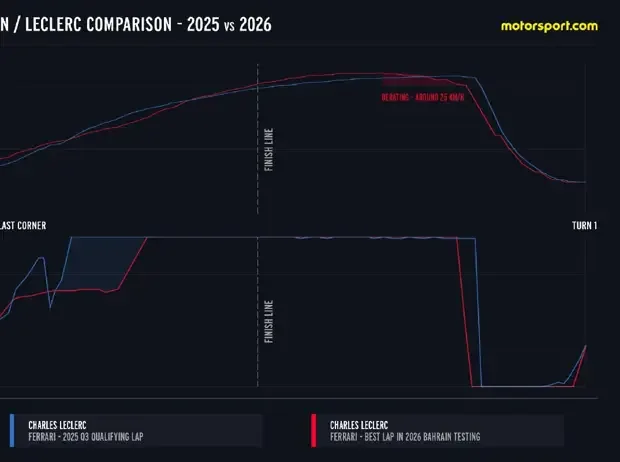
When overlaying both laps, it becomes clear that the higher electrical power and the expanded use of active aerodynamics – now also on the front axle – allow the finish line to be crossed at around 300 km/h, about ten km/h more than last year when full acceleration was already applied at the corner exit. However, the characteristic of the speed increase is decisive.
The difference to the previous year is 25 km/h
While the 2025 vehicles only reached their top speed with minimal derating shortly before the braking zone, the 2026 cars achieve their maximum speed earlier because the support from the MGU-K gradually decreases until finally only the internal combustion engine is working.
Result: Between reaching 328 km/h and lifting the accelerator pedal before the braking zone, Leclerc loses around 25 km/h because electrical support is no longer available.
If drivers were to accelerate fully at the exit of the last corner this year, there would be a risk with the current Formula 1 power units of reaching top speed exactly at the finish line and triggering the derating phase too early. This would affect the lap time not only on the start-finish straight but also on the following section up to Turn 4.
What Super-Clipping means
Incidentally, so-called super-clipping was observed there during the tests – the particularly early and abrupt onset of power loss on a straight when the electrical energy of the MGU-K is completely used up well before the braking point and the vehicle therefore only accelerates with pure combustion engine power.
On tracks with particularly long straights or several consecutive full-throttle sections, this effect is likely to be even stronger. The decision of when to accelerate fully during the preparation phase of a fast lap is therefore increasingly being made by the engineers – with the aim of optimally balancing battery management.
Read more The Anti-Horner? Laurent Mekies and his quiet revolution in Milton Keynes