(Motorsport-Total.com) – It is often taken for granted that Formula 1 has undergone a complete aerodynamic realignment for the 2026 season, as the controversies surrounding the power unit regulations have overshadowed everything else in public perception.
Read more George Russell warns: «Ferrari is now a real threat»

The regulations for 2026 are either praised or criticized, mostly solely because of the additional factor of energy management, which regardless of standpoint represents a certain simplification.
Perhaps this is because the chassis and aerodynamic rules were actually received positively – and approval is usually quieter than dissatisfaction.
Most drivers appreciate that the cars no longer stick quite as much “on rails” as in the previous era and require a more sensitive driving style than the stiffly tuned ground-effect cars from 2022 to 2025.
But how do you get the maximum out of them? It is no secret that the cars from 2022 to 2025 worked best when driven with as little ground clearance as possible, as the underfloor suction increased exponentially with every millimeter closer to the asphalt.
The difficulty: The underfloor aerodynamics were extremely sensitive, and even small flow separations or collapsing vortices could have serious consequences. These mechanisms led to porpoising and bouncing of the cars.
Therefore, the aerodynamicists initially took a path that generated more downforce at greater ground clearance, before significant performance gains were later achieved when porpoising was better controlled and the cars could be driven closer to the ground again.
The return to a more conventional aero package has somewhat reduced the importance of the underfloor and given surface aerodynamics more influence on downforce production. This does not mean that the underfloor can no longer generate significant amounts of downforce. Much is still invested here.
The ugliest ideas in Formula 1 history
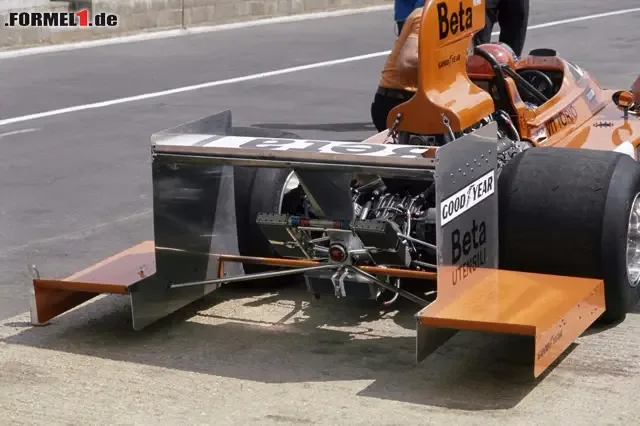
However, aerodynamicists must consider the car more holistically, instead of first developing the underfloor and aligning the rest of the car to keep it in the optimal operating window.
As the 2026 season progresses and teams push their updates, it is becoming increasingly clear where the crucial battlefields lie. The impact of aerodynamic developments has been enormous so far, and major shifts in the pecking order have often been accompanied by new upgrade packages.
McLaren got closer to Mercedes in Miami, Ferrari caught up in Barcelona, before Red Bull regained ground with its Austria package. “I think there are some technical aspects to consider,” says McLaren team principal Andrea Stella, emphasizing that his team had to adapt its development path to the observed trends in the field.
Aerodynamic concepts “not yet mature”
“The first point is that – unlike under the previous rules – the competitive picture is very constant and repeatable. Regardless of the track characteristics, currently Ferrari, Mercedes, then Red Bull and McLaren are ahead,” says Stella.
“So there is little dependence on track layout, corner type, or setup. That is the second point. Last year, you could gain a lot of downforce and improve your competitiveness by running as low as possible without porpoising or by mastering stiffness.”
“This year it is much harder to find such advantages through setup because the cars are less sensitive to ground clearance,” he explains. Although the 2026 cars are less stiff than their predecessors, it is also noted that cars before 2022 were tuned even softer.
Nevertheless, 2026 is not simply a return to that era, as factors like rake are no longer used to the same extent. In 2021, many teams ran with a very low front area and raised rear, causing the leading edge of the underfloor to act as an accelerator for the flow underneath.
However, tricks from 2017 to 2021 such as slots, cuts, and additions on the underfloor edges have been revived. Especially in the rear area in front of the rear wheels, there are many details that shape the flow and minimize disturbing influences from the tires.
Many teams work intensively on the underfloor edges to stabilize and increase the energy in the diffuser flow. “So where is the battlefield?” Stella continues. “First with the developments themselves. Every team brings updates, and at the top teams, large upgrade packages bring at least two to three tenths.”
“The second point is the concepts that are aerodynamically not yet mature. Our explanation for why we are not as competitive as hoped is that some of our original design decisions need to be revised,” says Stella.
Read more Next Williams defeat: Update does not deliver the hoped-for performance
“After analyzing other cars and further research, we realized that we need to rethink and further develop certain concepts,” he admits, emphasizing: “With upcoming updates, we will therefore change the concepts in some areas of the car and hope to gain additional performance faster.”
This is the current direction
Using McLaren as an example, it is easy to see where the trends are going. The MCL40 continues to rely on strongly downward-directed sidepods, while Ferrari and Mercedes have moved away from this and rely more on undercut solutions where the air takes a shorter path to the rear.
Red Bull, on the other hand, pursues a middle path and continues to use the so-called waterslide channel on the sidepods to expose the cola-bottle area at the rear. The flow is deliberately guided inward to increase the pressure difference between the top and bottom sides.
Also, with the nose, front wing, and the so-called “floor boards” behind the front wheels, McLaren goes its own way. It is not necessarily necessary to copy other concepts, but Stella considers it possible that inspiration from the competition is needed.
Formula 1 Quiz
Which Grand Prix of the 1988 season was NOT won by a McLaren driver?
Test yourself now in the Formula 1 quiz and compare yourself with other users
Convergence has always been part of Formula 1 history, from the innovations of Cooper and Lotus to the widespread adoption of Red Bull concepts in the ground-effect era. McLaren is also working on its own “Macarena wing,” which, in combination with active aerodynamics, is another building block in the 2026 overall picture.
In this context, the question arises whether the straight mode makes special low-drag packages unnecessary, since opening the front and rear wings already reduces drag. Stella considers it possible that teams will still develop special “low-drag variants,” as additional drag can be reduced even with open wings.
A good overall picture of the development so far is provided by the recently revised Cadillac. The new team has adopted sidepods that more closely resemble the concepts of Mercedes and Ferrari, with a pronounced undercut at the rear.
In addition, they rely on a stepped engine cover for better airflow to the rear wing as well as shaped endplates that create an upward effect and support the flow expansion at the rear. The comparison between the early version of the MAC-26 and the current car clearly shows the greatest progress.
What will the 2027 season bring?
Some changes are planned for the upcoming season to reduce downforce, as the FIA estimates the current loads to be higher than expected. This could also possibly be a contributing cause of energy problems on fast tracks.
In an interview on Aston Martin’s website, Adrian Newey explained the main adjustments and their effects: “On the chassis side, there are fewer but still significant changes [for 2027].”
“The biggest concerns the area at the front underfloor, often called ‘bib’ or ‘tea tray.’ The leading edge was moved about 300 millimeters, allowing the front of the car to be run lower. This brings new aerodynamic properties,” said Newey.
“There is also a flatter rear wing to reduce downforce, changes to the front underfloor – the so-called ‘bear claws’ or ‘fingers’ are reduced from five to three – as well as the ban of some tricks in the exhaust and rear wing area.”
“For us, the change at the front underfloor is crucial because it represents a new aerodynamic challenge,” explains Newey. Aston Martin already runs with slightly more “rake” than other teams, which is a typical Newey feature.
The new rules could lead to more teams relying more strongly on this approach again, as a greater angle of attack expands the effective area of the diffuser and increases downforce at the rear. At the same time, the rear becomes aerodynamically more sensitive if the flow is not sufficiently stabilized.
The small wing element at the exhaust introduced by Ferrari, which brought additional downforce points and was quickly adopted by other teams, will also disappear. However, it is likely that teams will find ways to partially regain the lost downforce.
Despite the rule changes, the progress from 2026 will form the basis for the 2027 cars. In a few years, a convergence of concepts is likely to be observed again. Currently, the leading car may be a Mercedes. But will the next dominator be an original or just a “copy”?
Read more George Russell warns: «Ferrari is now a real threat»