(Motorsport-Total.com) – Formula 1 has long since transformed from a purely mechanical discipline into a science of complex code, self-learning hybrid algorithms, and millimeter-precise calculated energy management.
Read more The world champions from the birth years of the current Formula 1 stars

Already at the start of the season, Lewis Hamilton warned that even hardcore fans needed a deep study of the rules to understand the complicated processes of modern power units. But what does the reality behind the closed doors of the engineers’ debriefings look like? Do the drivers possibly leave the endless meetings with more questions than answers?
McLaren driver Lando Norris gives a rarely honest insight into the daily work of a Grand Prix driver. Anyone who believes that the actors in the cockpit understand every line of code of their software in detail is mistaken.
Norris: Some things don’t make sense
The technical labyrinth of the top class regularly meets with incomprehension even among the main protagonists: “There are definitely moments and certain things that are harder to understand,” Norris admits frankly.
That the FIA regulators also sharpen the rules in the middle of the racing operation does not make things any easier. As a driver, you can simply shake your head at some decisions, because “there are still silly rules in places that just don’t make sense.”
How absurd this jungle of paragraphs can feel on the racetrack is illustrated by a look at recent rule adjustments. For example, the FIA intervened only at short notice from Friday to Saturday in Spa.
“Above a certain speed – at least 210 km/h – when you lift off the throttle and then get back on it, the amount of battery used or what happens between the combustion engine and the battery is still limited,” says Norris. The bitter conclusion from the driver’s perspective is sober: “Basically, it just wastes battery energy.”
Already in Japan, the world champion had complained that he had to overtake another car even though he actually didn’t want to. “There are still certain things where you ask yourself: Why does this even exist?” he says.
And time and again, you hear about problems because the programming intervenes when the driver does something other than calculated – because he makes a mistake, wants to give way, or is slowed down by blue flags.
Read more Race engineer is not coming after all: Albon looking for an alternative
Norris: You can’t even think about some things
The driver can’t always think about many things – and according to Norris, shouldn’t either. Anyone who starts pondering over the hybrid control’s calculations while driving simply loses focus: “You can’t even think about some of these things. If you constantly mull over such details, it’s over. As a driver, you just focus on driving,” he says.
At least this ensures that there are now fewer meetings for him “from which I come out thinking: ‘What am I supposed to do?'”
Formula 1 fails: These rule changes were a flop
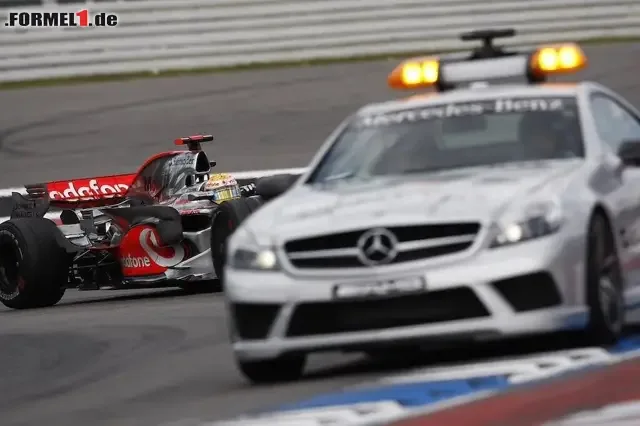
Nevertheless, the inherent logic of the hybrid era remains an adjustment for pure racers – for example, the fact that slower driving at the right moment can be rewarded. Sometimes just a nuance on the throttle is enough to completely throw the carefully calculated energy management overboard.
“There are simply situations where you ask yourself: Why was my battery empty here? That’s because you were on the throttle three meters longer here and three meters longer there. You didn’t have to avoid any car here, and that’s why the battery level was suddenly 20 percent lower,” Norris reveals the mathematical unpredictability.
Such factors are enormously frustrating for the athlete, because “that really shouldn’t have anything to do with actual racing, because it’s not our fault.”
The worst already behind the drivers?
How understandable the system presents itself during the race depends strongly on the character of the respective track. On demanding full-throttle tracks like Silverstone or Spa, man and machine reached their extreme limits. “I think we have almost seen the worst – at least I hope so,” the McLaren driver looks ahead with cautious optimism. But: Similar problems are expected again in Monza.
In the end, Norris demands bold improvements from the world governing body to give the sport back its transparency. After all, “there are some bigger problems that are very, very easy to fix. I hope we get these under control during this season and with a view to the next season.”
And where even the cleverest engineers reach their limits, the Brit does not shy away from radical thought experiments: “For some things, it would still be better if you simply scrapped the whole battery completely.”
Read more Formula 1 revenues plummet sharply: This is how the numbers can be explained