(Motorsport-Total.com) – Lewis Hamilton has fulfilled a childhood dream: The seven-time Formula 1 world champion bought a Ferrari F40 a few weeks ago, which he had extensively restored in Maranello. The story of the Italian sports car is so extraordinary that it almost sounds too crazy to be true.
Read more Red Bull out of the running: «Clear» problems in Monza
“It is a dream car of mine,” Hamilton recalls that he only parted with his entire car collection a few months ago. The Ferrari driver had actually lost interest, but he makes an exception for the legendary F40. “I had been looking for one for a while and wanted one with low mileage.”
The 41-year-old was specifically looking for a special car with a unique history. “In recent years, many have gone under the hammer at auctions – some with low mileage, but not particularly extraordinary, or maybe the paint had been renewed or something like that,” says Hamilton.
“I wanted to find the most authentic example and actually came across this one: The previous owner had bought it, driven it home from Maranello – 69 kilometers – then parked it and never started it again. The passenger door had never been opened. It was just covered and full of dust.”
Lewis Hamilton has his Ferrari F40 restored
For the seven-time Formula 1 world champion, it was quickly clear that he wanted to secure this special and extremely rare gem. “Then I faced the decision: What do you do with it?” Hamilton reveals. “Do you keep it as a piece of art, leave it dusty, or have it restored?”
“It took me a while to decide, and I finally had it restored because I wanted to drive it.” On Thursday, the Ferrari driver actually arrived in the paddock at Monza – typical Hamilton, carefully staged down to the smallest detail, including the right clothing.
“Because I realized what is actually quite crazy: I could be wrong, but I am pretty sure that in history no Ferrari driver has arrived in the coolest cars they own – these iconic models like the [250] GTO or F40.”
Enzo Ferrari did not make it easy for his drivers
“And I thought: I just have to do that,” says the Brit with a smile. Although younger Ferrari Formula 1 drivers have already appeared in top-tier road Ferraris, the question arises whether they actually paid for these cars themselves or if the cars were merely provided to them.
It is known that Enzo Ferrari always refused to give his drivers his own cars as gifts. John Surtees, for example, arrived in Maranello with a BMW 507, which Count Agusta had partially paid for as a gift for Surtees after he won the motorcycle world championship for the first time in the 1956 season.
The Ferrari boss explained quite bluntly that his driver should drive a Ferrari – but refused to even lend him one. The best offer Ferrari was willing to make was that Surtees bought the car at cost price.
And although it is widely reported that Ferrari eventually gave Surtees a 330GT 2+2 for winning the world championship in 1964, there are some doubts about this because this car was exchanged for the one he originally bought.
Fate? F40 engine carries Hamilton’s starting number
For Hamilton, the matter is clear: The Brit paid for his dream of the F40 himself and therefore already has a special relationship with his new Ferrari. “It was also crazy when they disassembled the car for inspection: First, it had stood the test of time. Everything still worked. Almost nothing had to be replaced.”
“And when they removed the engine, they discovered it bore the number 44. The number 44 was stamped into the engine,” says the Brit. “I could hardly believe it. I asked: ‘Did you know that? You must be joking.’ So it feels very much like fate.”
“And I thought it would be a real opportunity to honor Ferrari’s history in its home country and at their race – when else would I get to experience something like this again?” says Hamilton, who is deeply engaged with Ferrari’s heritage.
“I personally take it very seriously,” emphasizes the long-time Mercedes driver. “It is a phenomenal experience to be part of this brand and to see how it goes beyond the sport and has touched people all over the world – with its color, the logo, and these iconic cars.”
“For example, I showed one of the senior officials the F40 I drove in Japan, and he said: ‘Maybe you can drive a Luce next year.’ I just replied: ‘That’s just not the same as the F40.'”
F40 as one of Enzo Ferrari’s last projects
The F40 actually holds a special place in Ferrari’s history. When company boss Enzo Ferrari sold a majority stake in his company to Fiat in 1969, he gave up control over the road sports car division, while racing remained his personal domain.
The takeover by Fiat accelerated the end of those old models that were still handcrafted and paved the way for more conventional mass production methods – and, it must be said, a significantly more conservative approach to the product itself.
“The release of the F40 was one of the last decisions Enzo Ferrari made directly,” said then project manager Nicola Materazzi, considered the “father of the F40,” in an interview shortly before his death in 2022.
As Ferrari’s health deteriorated increasingly in the late 1980s, he became unmistakably aware of his own mortality. For the 40th anniversary of automobile production, he therefore wanted to create the most spectacular car possible as a legacy.
Read more Leclerc reveals form crisis: Thought about copying Hamilton
The success of the groundbreaking 288 GTO gave him additional momentum: The supercar was produced in a limited small series from 1984 to meet the FIA’s Group B homologation requirements and enable Ferrari’s return to rallying.
Development of the Ferrari F40 took place in secret
Fitting the idea that the F40 was essentially a “Vaffanculo” (Italian: “F*** you!”) to the Fiat suit-wearers and their stifling policy of mediocrity in all areas, the development was carried out under strict secrecy.
A large part of the design and production work was outsourced to long-standing partners and allies instead of taking place within the regular Ferrari structures. Materazzi was a versatile engineer who came to Ferrari in 1979 from Lancia via Osella – tasked with saving the problematic turbo engine project of the Formula 1 team.
Formula 1 Quiz
How many points did the Ferrari team score in Formula 1?
Test yourself now in the Formula 1 quiz and compare yourself with other users
His personal interest in aircraft engines and his experience with the turbo Lancia Stratos HF of Group 5, which had won the Giro d’Italia, gave him special expertise in solving problems with pre-ignition that occurred at high compression ratios.
Ferrari had only reluctantly embraced turbocharging in Formula 1 – and only when ground-effect aerodynamics made the mechanical layout of the long-used V12 naturally aspirated engine a disadvantage. The early turbo prototypes regularly broke down.
Ferrari F40 with Formula 1 technology for the road
But with Materazzi’s support, Ferrari quickly achieved competitive performance figures and at the same time higher reliability. He was also involved in innovations such as the technically interesting collaboration with fuel supplier Agip to combat pre-ignition by introducing tiny water droplets into the mixture.
The 2.9-liter V8 of the F40 with two turbochargers thus embodied the technology transfer from Formula 1 of that time. It produced 160 hp per liter and featured a then state-of-the-art engine electronics system that dynamically adjusted the fuel mixture as rpm and boost pressure increased.
To maintain secrecy, much of the detailed work was entrusted to the specialized engineering company Michelotto – as a reward for successful collaborations with Ferrari and Materazzi on other projects, including the 288 GTO.
In fact, two prototypes of the 288 GTO Evoluzione served as test beds for the mechanics of the F40 while the project took shape over a period of 13 months. Pininfarina’s chief designer Aldo Brovarone, shortly before retirement, supervised Pietro Camardella’s work on the body design.
All Ferrari Formula 1 cars since 1950
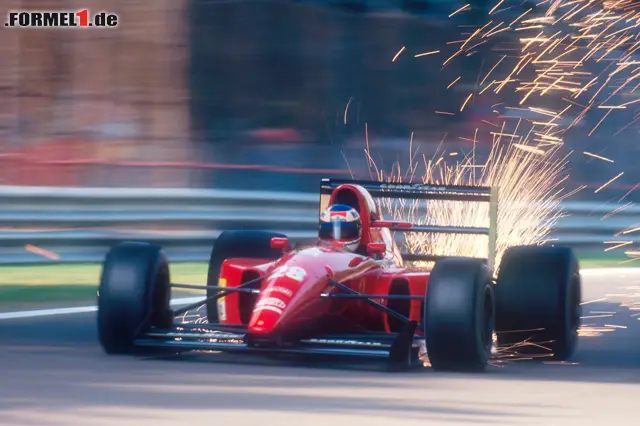
He is credited with adding the characteristic right-angled rear wing of the F40. When Michelotto made some changes to it after wind tunnel tests, this was seen as an affront – Brovarone had designed many influential Ferraris, including the Superamerica and the Dino 246 GT. Pininfarina then briefly demanded that his own name be removed from the project.
Ferrari relied on uncompromising lightweight construction for the F40
Only the final assembly of the F40 took place in Maranello. The subcontractors formed a veritable who’s who of Ferrari suppliers from the golden age of handcrafted manufacturing: Vaccari from Modena supplied the tubular frame chassis, Scaglietti added the composite reinforcements, and Dino Cognolato, a neighbor of Michelotto, even made the composite bodywork.
As a race car for the road, the F40 made a virtue of numerous weight reduction measures. The paint was applied so thinly that the carbon fiber structure is visible from certain angles. In fact, improper repainting is still a sure way to reduce the value of a used F40 today.
There was not even wiring for a radio, and the door handles consisted of fabric loops instead of molded handles. Early models had fixed plexiglass side windows with only a small sliding window.
However, this was changed after owners who actually wanted to drive their cars complained about the inconvenience when paying tolls on the Autostrada.
How the Ferrari F40 became a coveted cult object
Originally, Ferrari planned to build only 400 units. Given the enormous demand, more than three times as many were eventually produced. Any concerns of the Fiat bureaucracy about this special project were quickly dispelled given its impact on the business results.
Since it was Ferrari in the 1980s, the records from that time are not entirely clear. It is assumed that between 1311 and 1315 F40s were built. Part of the difference can be explained by a handful of right-hand drive cars that were probably made in the Pininfarina factories for the Sultan of Brunei.
Many of the vehicles disappeared into private collections. The F40 laid the foundation – more than many other cars of its kind – for rare “less is more” special models aimed at wealthy customers. Hamilton’s F40 was one of those examples that only made a single trip from the factory.
However, that is not the only reason why the Formula 1 world champion has already grown fond of his new gem. “I think the nostalgic, iconic curves and lines with which these cars were built back then – there is simply no second time for something like that,” he says.
“Of course, there is also the F80, which is pretty cool, or the F50, but for me the F40 remains something special; I remember as a kid lining up all these cars, and the red car – the F40 – was my absolute favorite. That I would ever have the chance to own one was completely beyond my imagination back then.”
Read more Formula 1 Live Ticker: The Qualifying in Monza live!