(Motorsport-Total.com) – While Kimi Räikkönen’s McLaren is on pole position in Monza, 21-year-old Lewis Hamilton gazes into the distance as he accompanies team boss Ron Dennis to the starting grid of the Italian Grand Prix.
Read more Son of Kimi Räikkönen becomes Red Bull junior

Hamilton stares towards the tight Turn 1 at Monza and imagines what it would feel like in 2007 to be on pole position in Formula 1 for the team he has been connected with since his karting days.
The day before, Hamilton had won the GP2 championship after a turbulent season marked by hardships, a torn McLaren contract, and two fascinating weekends in Silverstone and Istanbul that introduced the young Brit to the world.
Hamilton’s then team boss is also his current one. Frederic Vasseur, now at Ferrari, teamed up with Nicolas Todt to transform his French ASM team into ART Grand Prix and compete in formula racing when the McLaren-supported Hamilton met him, racing for Manor in Formula Renault and Formula 3.
Hamilton did not take long to make a lasting impression and finished fourth as a rookie in the Formula 3 Euro Series. But when the new GP2 series was announced to replace Formula 3000 as the final stepping stone to Formula 1, Hamilton and his father and manager Anthony wanted to move up directly.
Hamilton lost his McLaren contract
When asked by Autosport about his memories of that time, Hamilton says: “It was an interesting time in my life. I was, like every young kid, eager to get into Formula 1 and hoped that I could make it someday without knowing when that chance would come.”
“I called Martin [Whitmarsh] every week and asked him when I could get into the car. In 2005, when the GP2 series started, I pushed for it because I thought there was a chance to win it in the first season since it was a new class.”
However, McLaren wanted him to stay another year in Formula 3, which led director Martin Whitmarsh to tear up Hamilton’s contract. Hamilton called this episode “one of the toughest periods of my life.”
The junior titles of Formula 1 drivers 2026
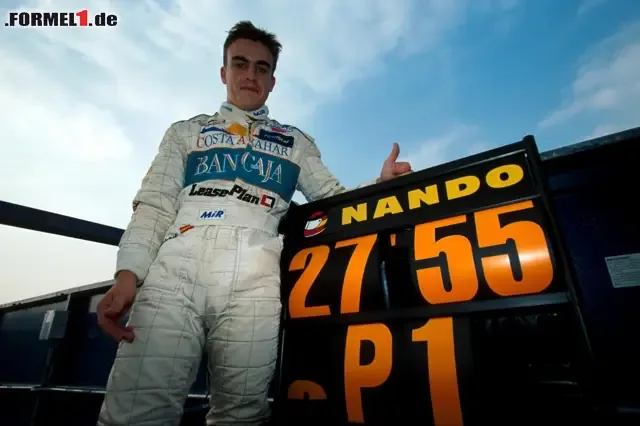
But together with Vasseur’s team, he did what McLaren demanded of him: to develop as a driver by dominating the competition in Formula 3. “I managed to get to the next races in Formula 3, won them, and got the contract back,” said Hamilton.
His dominant title in the 2005 Formula 3 Euro Series with 15 wins and 13 pole positions from 20 races made Vasseur realize he had a special talent on his hands. Vasseur’s ART had just won the first GP2 title with Hamilton’s old karting friend Nico Rosberg, so it was an easy decision for McLaren to stay with the team in 2006.
Hamilton’s difficult GP2 start
“I remember the first test with Fred in Jerez,” says Hamilton. “When I came back and saw his reaction, he was obviously very positive. I knew that everything he saw would go back to Ron.”
Given Hamilton’s strong Formula 3 form, Vasseur expected a similar result in 2006. “I was convinced we would do well in GP2 because we had won the championship with another rookie, Nico,” Vasseur recalls to Autosport.
“But it was a bit harder because we switched from slicks to treaded tires. It was not an easy step from Formula 3 to GP2. In GP2, testing and track time are limited compared to Formula 3.”
Formula 1 Quiz
Who is the Formula 1 driver with the most wins?
Test yourself now in the Formula 1 quiz and compare yourself with other users
“We had difficulties at the start of the season, we were far off. I remember Imola was tough when Lewis was disqualified for overtaking the safety car. We lost many points to Piquet. But after three or four races, we started winning and he put in a mega streak.”
Read more TV ratings Monza: Fewer viewers — but this rating stands out
Hamilton took the lead with wins in Germany and Monaco, but it was his home weekend in Silverstone that really stood out when he overtook title rival Nelson Piquet Jr. to claim his third consecutive win, including the reverse grid race.
“The most impressive race I’ve ever seen”
But three weekends later, Piquet countered in Hungary when Hamilton had two crashes, opening the door for a title duel. “After Silverstone, it was not official that he would go to Formula 1. I knew it, I don’t know if he knew,” recalls Vasseur.
“We arrived in Budapest and it was a real disaster. He crashed in the first lap of practice, in the first lap of qualifying. We had to go to the stewards. It was a very difficult weekend.”
But Hamilton came back in Turkey, the penultimate race weekend of the season. After spinning in lap 2 of the sprint race with a low-downforce setup, Hamilton started an extraordinary comeback, flying through the field, including an overtake on Piquet.
Hamilton finished second behind winner Andreas Zuber and stopped his rival’s momentum in the championship. “It was a special race to come back from that spin,” says Hamilton. “That year was mega.”
To this day, Vasseur still calls Hamilton’s Istanbul comeback the greatest performance he has ever seen on a racetrack. “Turkey was, I would say, the most impressive race I have ever seen in my life,” said the Frenchman.
“With Lewis, we had this feeling at the pit wall that nothing could happen to him. In 15 laps, he overtook everyone, but we were always relaxed. It was the most impressive race I have ever seen.”
Reunion in Formula 1
Hamilton secured the title at the season finale in Monza, and the rest is, as they say, history. But when asked 20 years later about his outstanding memory of the year, Hamilton says it was that walk across the grid in Monza with Dennis when he realized that Räikkönen’s car would be his the following year.
“I will always remember standing on the grid in Monza with Ron in front of Kimi’s car,” says Hamilton. “That was the moment my life really changed.”
Vasseur eventually also went into Formula 1, joining Ferrari in 2023 via Renault and Sauber, and was instrumental in bringing Hamilton to Maranello to revive their working relationship.
But as a true racer, Vasseur naturally likes to look back on his ART days, from dominance in the crucial Formula 3 Euro Series to the stormy conquest of the young GP2 series with Rosberg and Hamilton. All with a much smaller team, far from the limelight and political machinations of Formula 1.
This success series established ART for several years as a benchmark in European formula racing and produced future Formula 1 drivers including Paul di Resta, Romain Grosjean, Jules Bianchi, and Nico Hülkenberg.
“We probably stayed like that for five seasons,” Vasseur reminisces. “Those first two GP2 seasons with Nico and Lewis were a turning point for us, the work with Williams and McLaren and so on. That was a good journey. A really good journey.”
Read more Michael Schumacher and Ferrari: Only love at second sight?