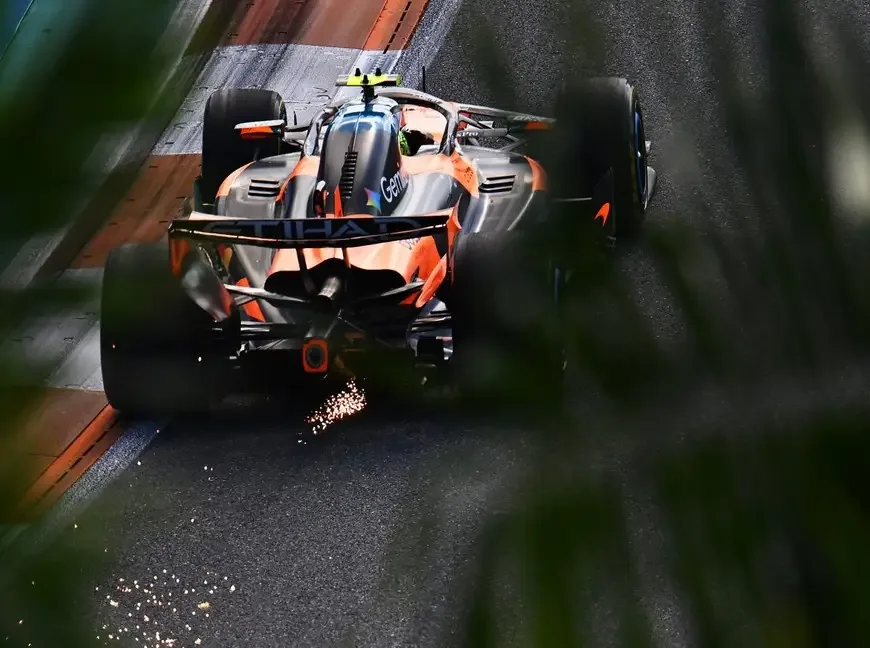
(Motorsport-Total.com) – The much-praised changes to Formula 1’s energy management had subtle effects during the Miami practice and sprint qualifying sessions, but it is still too early to call them a success. And is this the limit of what Formula 1 can achieve with the current hardware?
This week, the FIA World Council ratified a series of adjustments to the way Formula 1 cars manage electrical energy over a lap, as agreed by the parties involved after a series of high-level meetings in April.
It had been known since the pre-season testing that changes were coming, but schedules and priorities shifted in response to events. Oliver Bearman’s high-speed crash in Japan, triggered by a large speed differential compared to Franco Colapinto’s Alpine, pushed safety to the top of the agenda.
Previously, the question was what to do in qualifying. Drivers had complained that the energy management requirements prevented them from pushing as hard as possible in qualifying. This sentiment was shared by fans, who felt that techniques like “Lift-and-Coast” and “Super Clipping” had no place in the fight for pole position.
Battery pack is the bottleneck
The sprint qualifying in Miami offered a first glimpse of how effective the changes might be. By lowering the energy recovery limit per lap in qualifying from 8 megajoules (MJ) to 7 MJ and increasing the “Super Clipping” rate from 250 kilowatts to 350 kW, the FIA tried to reduce the time cars spend in “Super Clipping” mode.
The battery pack in Formula 1 cars is the bottleneck, as it can only store 4 MJ. The adjustment process was therefore a balancing act. A too drastic cut in allowable recovery would slow the cars down too much, and those responsible for “the show” were naturally cautious about the impact on lap times.
The goal was to find a “sweet spot” where the reduction in recoverable energy has a noticeable effect to make charging less disruptive. This was intended to avoid the pronounced speed losses that made “Super Clipping” or “Lift-and-Coast” necessary, without sacrificing too much speed on the straights.
Theory and practice
Simulation data released by McLaren last week showed how the changes could work by essentially smoothing out some of the peaks and valleys in speed caused by the deployment and recovery process during the lap.
The aim of the revised regulations was essentially to trade some of the top speeds observed this year for a more natural driving feel. The instant torque surge of the electric motor had previously pushed cars to higher top speeds earlier, which then dropped off as the charge decreased and had to be somehow restored.
This “somehow” took the form of “Super Clipping,” where the MGU-K acts as a magnetic resistance against the combustion engine’s power at full throttle on the straights, generating electrical energy. Since much of this, along with part of the energy deployment, was determined by machine learning algorithms, it reduced the drivers’ influence and frustrated both them and the fans.
Simulations match reality quite closely
So how were these simulations implemented in reality? Quite accurately, as it turned out, although the changes did not produce the huge difference some might have expected.
It was definitely confirmed that top speeds on the straights would be lower than without the rule changes, but the cars would arrive faster at braking zones. The practice and sprint qualifying on the first day in Miami were characterized by numerous locked wheels before key corners. Bumps on the track and thermal factors in the tires also played a role, but Pirelli hinted that the new energy management system contributed its part.
Formula 1 fails: These rule changes were a flop
How large this share is is difficult to determine. Miami was a track where the effects of the revised regulations would be subtle anyway due to the track characteristics. There is a balanced ratio of straights to corners with heavy braking phases where energy can be recovered unobtrusively. Added to this are several acceleration zones where drivers must control traction to avoid thermal degradation of the rear tires.
Why there is more locking under braking again
“The big effects showed up mainly with the locked wheels because we no longer have this ‘Super Clipping,’ or it is less obvious,” said Pirelli chief engineer Simone Berra.
“So you reach the corner at a higher speed, and with the old power unit regulations, there would probably be fewer cases of locked wheels. Now you are more at the limit of tire grip. That is the main situation we saw today.”
For engineers, this may seem like a small shift, but seeing Formula 1 cars at the limit of grip was one of the desired outcomes of the rule changes, so the parties involved will gladly count this as a success.
Real acid test only in Barcelona?
Although it is not possible with the available data to compare a qualifying lap in Miami under the revised rules exactly with the system from the first three races, it is clear how much management was done. Looking at Lando Norris’ pole lap in the sprint, it is evident that he did a bit of “Lift-and-Coast” in corners 4, 5, and 6 before braking for corner 7.
A speed drop from 337 km/h to 307 km/h between corners 10 and 11 despite full throttle suggests “Super Clipping,” followed by another short “Lift-and-Coast” before braking. The linearity of the speed curve on the back straight also indicates that the new rules work as intended, with a gradual increase up to the apex before a gentle drop from 341 km/h to 320 km/h.
Formula 1 quiz
In which year did David Coulthard first start a Formula 1 race?
Test yourself now in the Formula 1 quiz and compare yourself with other users
The overall difference is therefore not transformative, and the drivers who commented reacted rather reservedly. “I didn’t really feel a big difference in qualifying,” said Valtteri Bottas. “That might be different with cars that spend more time at full throttle.”
Since the next stop is Canada, another track with relatively high energy demand, followed by Monaco, where energy management will be almost irrelevant, the full effects of the revised regulations on qualifying may only become visible in Barcelona. However, there is a general awareness that with the current format splitting nearly 50-50 between electric power and combustion engine, compromises are inevitable.
Real changes might have to wait until next year, as there is already talk of a shift to 60-40 being under discussion.
“I think it is a step in the right direction for the sport,” said Red Bull team principal Laurent Mekies about the impact of the recent adjustments. “I think it is probably the best we could have done with the current hardware, and I believe everyone has coped quite well with it so far.”