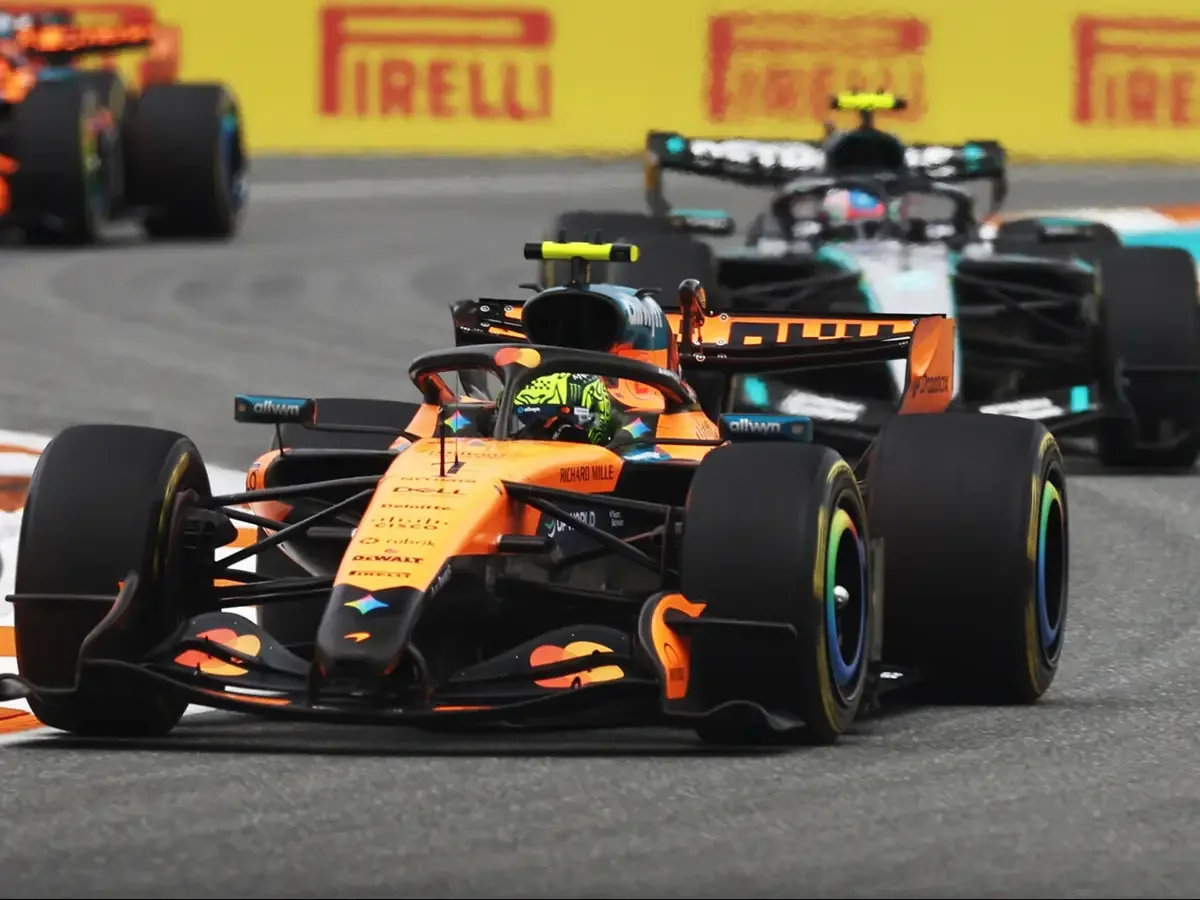
(Motorsport-Total.com) – Immediately after the Formula 1 race in Miami, which Norris led for much of the first stint before being overtaken by the eventual winner Kimi Antonelli via an undercut, McLaren team principal Andrea Stella initially concluded that the timing of the pit stop was the decisive factor for the missed possible victory.
Read more Behind the F1 Scenes: Unique Spielberg Experience Up for Auction!
If Norris had stopped before Antonelli instead of a lap later, he would have had the advantage of warmer tires when exiting the pit lane – and possibly won the subsequent duel in turns 2 and 3.
“He probably could have defended the lead with an earlier stop,” Stella admits in an interview with Sky. “We will analyze that. There are always possibilities when racing is this close.”
McLaren’s pit stop timing under the microscope
In hindsight, many things seem crystal clear. But strategy is only part of the overall picture. It is crucial to always evaluate strategic decisions based on the knowledge available at the time – not based on the later known result. Otherwise, you are moving into the realm of “would have, could have, if”.
With some distance, Stella added further context after the race. According to him, McLaren still had the strength from the previous year to keep the tires consistently in the optimal window, but Mercedes had the edge in pure pace. Also because the car generates more downforce, even though it was one of the few teams that did not bring a major upgrade package to Miami.
This led to different performance profiles over the lap, with the balance of power further distorted by Mercedes not working optimally on Friday and partly on Saturday.
Stella: It’s not as simple as it seems …
Regarding whether Norris could still have won the race after comfortably leading following the early safety car phase and overtaking Charles Leclerc, Stella points to other influencing factors beyond pit stop timing.
“When everything is this close and four teams are fighting on equal terms, execution, adaptability, and optimization become the decisive factors,” he explains. “Overall, we had a very positive weekend, but in the race, we possibly lost the chance to win due to execution and optimal use of our opportunities. We fought against a faster car, but maybe we could have won if we had kept Lando at the front.”
“If you go into detail: If you lead and are able to defend the lead – as Lando did in the first stint – then you definitely have a chance to win. Pit stop timing was a decisive factor, but we should not look at it only from a strategic perspective. Because timing also includes the time in the pit lane. An execution aspect. It is a combination of the driver stopping, the actual stop, and the in-lap. We also lost time there.”
“You must not see it purely strategically. It is always a team effort. As a team, we did a great job to make McLaren competitive again. But as a team, maybe we did not get the maximum out today. But you must not forget that we raced against faster opponents.”
How Norris even got into the fight for the win
Norris started from 4th place but got a better start than polesitter Antonelli and benefited from both the Mercedes and Max Verstappen’s Red Bull going off track in the first corners. Together with Antonelli, he then overtook Leclerc, and the two were in 1st and 2nd place after the early safety car phase.
Although Norris was able to extend his lead to three seconds at times, Antonelli began to reduce the gap as the race approached the pit stop phase. On lap 26, Antonelli pitted, switching from medium to hard tires, while the gap was about 1.7 to 1.9 seconds.
Read more One-time statistic: Kimi Antonelli surpasses Schumacher and Häkkinen
Norris’ first reaction: Lost the win
Norris stopped a lap later – and rejoined the track exactly at the moment Antonelli passed with warm tires and the ideal line. “It’s quite simple: we should have come to the pits first,” he complains. “We have to be honest and admit that we should have stopped earlier. We shouldn’t have waited.”
At the same time, the McLaren driver admits: “He (Antonelli; editor’s note) was faster at that point in the race. I told the team that on the radio, but we didn’t really react. I think we could have won if we had fought harder. […] But his pace was better than ours today.”
After both had overtaken Max Verstappen, it took seven laps for Norris to get back within a second. However, after six laps in the DRS window, he fell back and did not get decisively closer again.
Stella: Could not have done much differently
So what could McLaren have done better? “With the hard tires, it is very difficult,” says Stella. “Even if Lando had been ahead when exiting: Antonelli comes with warm tires and the ideal line. I don’t think we could have done much differently.”
“We should have kept Lando significantly further ahead – maybe seven tenths. Then he could have defended the position. The pit stop was not perfect, we lost time, and the in-lap was not ideal either. With Antonelli on warm tires, it was extremely difficult. It is a combination of several factors.”
The undercut is generally not very strong in Miami, so details decide. Antonelli’s pit stop took 2.2 seconds, Norris was 0.6 seconds longer. Data analysis shows: Norris’ in-lap was not perfect but also not dramatically bad. Directly in turn 2, he lost just over a tenth because he had to lift earlier. Other small mistakes added up, for example braking into turn 7 and in the technical middle section.
In the meantime, the gap grew to almost four tenths, but on the back straight, Norris made up time again by using more electrical energy and was almost at the level of his previous lap at the end of the lap.
Nevertheless: Antonelli’s in-lap was significantly faster at 1:37.884 minutes compared to Norris’ 1:38.504 minutes. Especially on the back straight, Antonelli used more electrical power. That was where the decisive advantage for the undercut arose.
It remains open whether an identical pit stop or a different procedure when entering and exiting would have changed the outcome. McLaren will examine exactly these questions in the post-analysis: “We will analyze how much of the lost time in the pit lane is attributable to the driving part and how much to the actual stop,” says Stella.
“Our pit stops were not perfect today. Compared to an ideal stop, we lost a few tenths. Mainly in the execution itself, less in the approach or departure.”
Read more Fernando Alonso sounds the alarm: No updates until summer