(Motorsport-Total.com) – When people think of Michael Schumacher’s time at Ferrari, they usually have the dominant years between 2000 and 2004 in mind. But the German’s first season in red was anything but easy.
Read more With special paint: McLaren celebrates 1,000 Formula 1 races

After winning two consecutive world championships with Benetton in 1994 and 1995, Schumacher was convinced by Jean Todt to switch to Ferrari for 1996. However, both driver and team embarked on a huge rebuilding project.
Todt had taken office in July 1993 to restore Ferrari to its former glory and initiated profound changes ahead of Schumacher’s arrival. After 1995, Ferrari not only parted ways with Jean Alesi and Gerhard Berger but also said goodbye to its iconic V12 engine in favor of a newly developed V10 power unit.
Technical director John Barnard designed a completely new car for 1996: the F310. Powered by Ferrari’s new V10, it immediately raised eyebrows.
Years later, Schumacher’s teammate Eddie Irvine recalled his first impression of the car: “I remember seeing it for the first time and saying, ‘That looks worryingly different from the other cars.’ We had simply gotten it wrong. After the Jaguar R2, it was the worst car I have ever driven.”
“How Michael managed to drive that car will always remain a mystery to me,” Irvine added. “I was scared when turning in because you never knew if the car would react immediately, half a second later, or only after a whole second.”
Michael Schumacher: The Ferrari Years
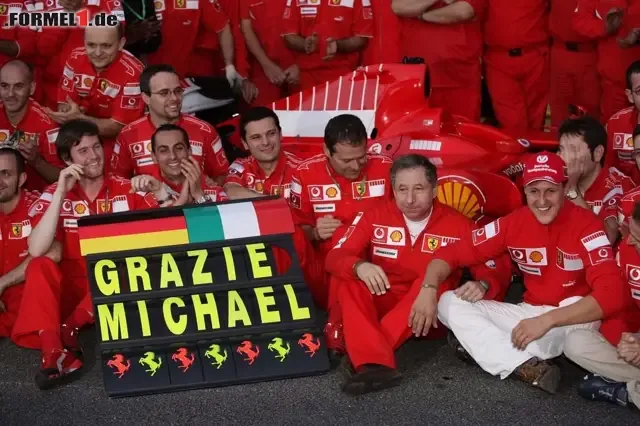
Schumacher himself was anything but enthusiastic about the F310 and nicknamed it “the parachute” because of the drag caused by its bulky design. The car was not only an aerodynamic compromise but also suffered from massive gearbox reliability problems.
But when it worked, the F310 could at least stay within striking distance of the dominant Williams FW18s of Damon Hill and Jacques Villeneuve. And on the right day, under the right conditions, Schumacher could achieve something extraordinary.
That day came on June 2, 1996, in Barcelona.
The Magic of Barcelona
Hill and Villeneuve had confidently secured the front row in dry qualifying. Schumacher qualified third but was more than half a second behind the Williams duo.
“I never felt like I could get pole position,” Schumacher admitted. “I wasn’t competitive enough. I think this result clearly shows the current situation from a technical perspective. I got the absolute maximum out of the car.”
But the weather completely turned the race weekend upside down overnight. Rain started on Saturday afternoon and turned into torrential downpours by Sunday morning. There was even discussion about starting the race behind the safety car, but the organizers ultimately decided on a conventional standing start.
Chaos in the Wet
Hill got off to a bad start, but Schumacher’s start was even worse due to clutch problems, dropping him from third to seventh. Villeneuve led into turn 1 ahead of Jean Alesi’s Benetton, with Hill third. Gerhard Berger was fourth, Rubens Barrichello fifth, and Irvine sixth, just ahead of Schumacher.
Read more Antonelli rejection to Ferrari: «The goal is to win with Mercedes»
Visibility was practically zero due to spray. In the second lap, Irvine spun, stopped, and had to retire from the race early.
Formula 1 Quiz
In which year did Michael Schumacher achieve his first Grand Prix win?
Test yourself now in the Formula 1 quiz and compare yourself with other users
Schumacher soon fought his way up to fifth place and, together with Berger, passed Hill, who was visibly struggling to keep his Williams under control. The unfortunate afternoon for the championship leader ended shortly after when he crashed into the pit wall.
“I’m mainly just glad I’m uninjured,” Hill said afterward. “It was a terrible day.”
The Rain Master
The race then became a demonstration of why Schumacher earned the nickname “Rain Master.” He overtook Berger to take third place and quickly caught Villeneuve and Alesi. Neither could keep up with Schumacher under the increasingly worsening conditions, and on lap 12, he took the lead.

Once in the lead, he pulled away from the field. His fastest lap was an astronomical 2.2 seconds faster than anyone else’s, although his race was not entirely trouble-free.
Ferrari’s new V10 experienced misfires and seemed at times close to giving up. “I was basically driving with an eight- or nine-cylinder engine,” Schumacher explained afterward. “I had much less power and lost about ten km/h on the straights.”
First Win for Ferrari
Fortunately for Schumacher, the competition lost even more time under the treacherous conditions. His lead kept growing, and after his second pit stop, he was more than a minute ahead of Alesi. Ferrari then instructed their driver to ease off and focus on bringing the car home safely.
Schumacher did as told and eventually crossed the finish line with a 45-second lead over the rest of the field, securing his first win for Ferrari.

Team boss Jean Todt called the drive “incredible,” while Ferrari president Luca di Montezemolo praised Schumacher as an “exceptional” driver.
Schumacher would go on to score two more wins with the F310 later in the season, but for many, Barcelona 1996 remains the defining performance of his Ferrari career. Or, as Irvine later put it: “The greatest achievement in the history of Formula 1.”
Read more Aston-Martin-Honda: Solved problems reveal new difficulties