
(Motorsport-Total.com) – A race car made of building blocks. That immediately brings back childhood memories for me: How, as an elementary school student, I enthusiastically tried to rebuild Michael Schumacher’s Formula 1 Ferrari – and how I soon realized that reality is not so easily replicated with building blocks.

That was in the 1990s. In 2026, I made a new attempt: This time not “freehand,” but according to plan – with the Mercedes-AMG GT3 from the Chinese building block manufacturer CaDA.
The car comes in a 1:8 scale and with 5,466 parts, also with an official Mercedes license and high praise in advance: The set is said to be “engineering you can touch,” promises the star brand. Under the hood is “pure mechanics” and a “sophisticatedly designed 8-speed transmission.” And all this currently for around 375 euros (see the offer on Amazon!).
What you get for all that money
At that price, you naturally have to swallow first. But: You quickly realize that you are not just dealing with a pile of plastic here, but with a truly high-quality set – as shown by the visual presentation of the boxes and how everything is portioned inside: like in the well-organized workshop you trust.

My second look went to the manual: Let’s see what is offered there. And I was quite amazed: There are two thick booklets with 400 pages each. At that moment, the true dimension of this building project really became clear to me.
The first impression of the CaDA Mercedes
For the start, I didn’t begin at the front but picked something from the middle: Because although I had built technical sets before, I mainly dealt with “City” products, I chose the driver’s seat – because it contains many traditional building blocks.
In general, I find: With “normal” bricks, you immediately notice what they can do. If they are not the bricks from the Danish market leader, you often feel a difference. Here it is different: The CaDA bricks don’t smell, they fit well, don’t wobble, and can be separated cleanly again with normal effort. A good first impression.
For safety, I also brought in an expert: my 6-year-old son, who loves building blocks even more than I do. And he also handled the material well, although the set is naturally aimed at much older builders – primarily adults (the official manufacturer recommendation is “from 14 years”).
Clear instructions, no stickers
The instructions are generally understandable and well prepared, sensibly portioned, and provided with practical size references. In the evening twilight, the only difficulty I had was distinguishing between parts in dark gray and black. The contrast in the printed instructions could be a bit better there.
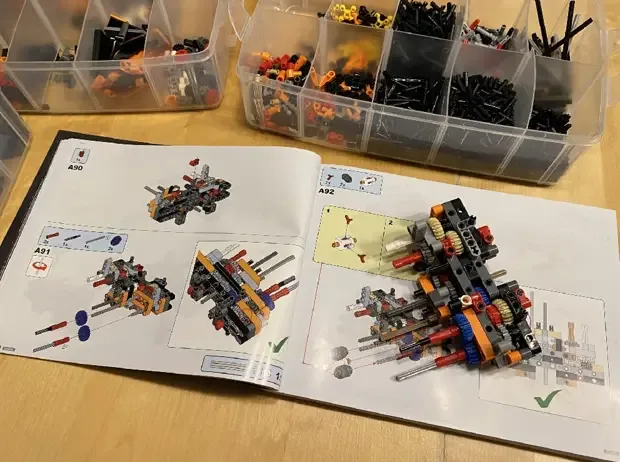
A few small inconsistencies have also crept in: Arrows sometimes point in the wrong direction when parts have to be attached to other parts. But that was not a big problem because in the end, what belongs together still comes together.
I also noticed: There are no stickers – unlike the market leader from Denmark, where some sets require a lot of sticking. Here, there are prints. That naturally looks more elegant and also much better.
Sorting boxes help keep track
To avoid losing track with the sheer number of parts (which are sensibly pre-sorted in “portion bags”), I strongly recommend sorting aids like boxes or containers. These are not included but are usually available in the households of experienced builders anyway. And they are needed here if you want to build mainly and not spend most of the time searching. But to each their own: Both have their charm.
So how is the building? You might guess from the two instruction booklets: time-consuming. I easily lost myself in the building blocks for several evenings and built for many hours to complete about a quarter of the first booklet. So you can have long-lasting fun with such a set.
The attention to detail is remarkable
While building, I immediately noticed that the manufacturer and licensor did not exaggerate: The attention to detail is remarkable. Because after the seat, I actually started at the front in the manual – with the complex transmission. And what can I say? Gears, belts, and levers – everything is there, a small technical marvel, built from hundreds of building blocks in all shapes and sizes.
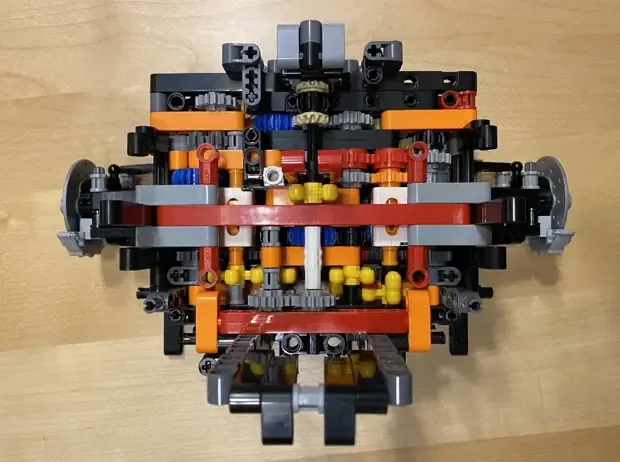
Builder’s pride is also involved when you see how the moving parts mesh and work together – hopefully they work! Because a subsequent error correction is rather not planned. Too many parts are too interlocked at the end to easily go back to a specific spot. I tried it (out of necessity)…
A real eye-catcher on the shelf
The building project is still a trial: I have not managed to assemble the entire car in recent weeks. But that is not a problem: You can always have a lot of fun with this set because there is still much to come: the engine, the chassis, the steering, and even a mechanism to jack up the car. You can even make the headlights light up here.
Sometime, the building block Mercedes will be about 60 centimeters long, 25 wide, and 17 high and a real eye-catcher – and then it will get a place of honor on the shelf in my study. Definitely. And with half an eye, I am already looking at the Formula 1 Alpine with 2,170 parts…
But now, please excuse me – I have to go back to my pit lane and build a race car…
Transparency note: The building block set was provided to us free of charge by the manufacturer CaDA. There was no influence from CaDA on the article, and there was no obligation to publish.
This article contains affiliate links from Amazon, through which products can be purchased. If a purchase is made via such a link, we receive a commission. There are no additional costs for you.