(Motorsport-Total.com) – After the first three race weekends of the 2026 Formula 1 season, it’s worth taking a detailed look at the internal team duels: Who is currently the faster driver? Who impresses in qualifying, who in the race? Who do the new rules suit – and who can surprise?
Read more Advantage gone: Is Max Verstappen now experiencing the Vettel fate?
McLaren: World Champion Norris struggles with new rules
At the world champion team McLaren, Oscar Piastri currently has the upper hand. In qualifying, the Australian is on average 0,14 seconds faster than his teammate Lando Norris. In race trim, the lead is even more significant, averaging 0,24 seconds per lap.
With this, Piastri has made a clear step forward compared to 2025. Back then, Norris was still ahead by an average of 0,06 seconds in qualifying and 0,03 seconds per lap in the race.
However, caution is advised: both McLarens have been repeatedly slowed down by technical problems so far this season, which cost a lot of track time and make comparability difficult. Nevertheless, a clear trend is recognizable.
Mercedes: Antonelli with a huge step over the winter
The comparison at Mercedes is significantly more representative, as both Andrea Kimi Antonelli and George Russell have completed all relevant sessions so far. The Italian is currently an average of 0,08 seconds ahead of his teammate in qualifying and 0,17 seconds per lap in race trim.
This means the balance of power has completely reversed compared to 2025. Back then, Russell was still almost exactly three-tenths faster than the then-rookie Antonelli in both disciplines. The development could be attributed to both the new rules and Antonelli’s increased experience.
Hadjar on par: Verstappen myth broken?
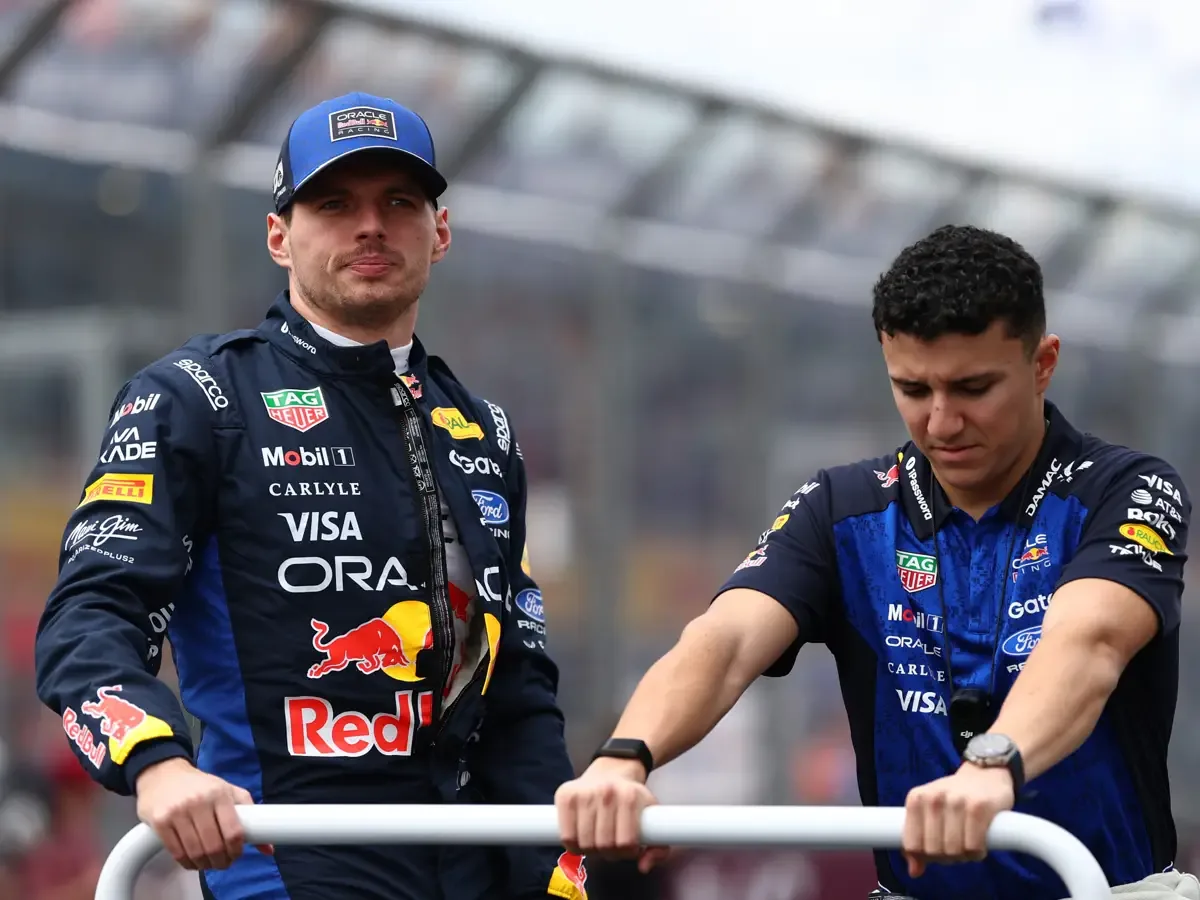
The new team duel at Red Bull was awaited with excitement – and so far, a surprising picture is emerging. Isack Hadjar is currently an average of 0,08 seconds faster than Max Verstappen in qualifying. In the race, however, the balance of power completely reverses: there, Verstappen is on average about half a second per lap faster.
One thing is certain: Hadjar is a significant improvement over his predecessors. In 2025, Yuki Tsunoda was on average 0,81 seconds behind Verstappen in qualifying and 1,07 seconds per lap in the race. For Liam Lawson, it was as much as 1,49 seconds in qualifying and 1,86 seconds per lap in race trim.
However, the large discrepancy between qualifying and race pace raises questions. As early as 2025, it could be observed that Lawson was closer to Hadjar in the race at Racing Bulls than in qualifying – a possible indication of a pace problem for the Frenchman in race trim.
However, it is questionable whether this alone explains a difference of over half a second. The new rules could also play a role: drivers report that they can no longer make as much of a difference in qualifying.
Because it’s clear: the earlier you get on the gas and the later you brake, the less battery power is available. “Crazy laps,” as Charles Leclerc it formulated, are currently hardly possible anymore. It is therefore quite possible that qualifying under the new regulations is no longer a reliable indicator of pure driver pace.
Nevertheless, it is striking that hardly any other team shows such a strong shift compared to the previous year. Max Verstappen’s current qualifying weakness therefore remains an open mystery.
Ferrari: Hamilton upswing an illusion?
At Ferrari, the duel currently favors Charles Leclerc. The Monegasque is on average 0,13 seconds faster in qualifying and 0,07 seconds per lap in race trim than Lewis Hamilton. For Hamilton, this is still progress, as in 2025 he was still 0,25 seconds behind in both categories.
However, it remains to be seen how sustainable this trend is, as the tracks so far have suited Hamilton. Australia and China are traditionally among his stronger tracks, while Leclerc has historically had more problems there.
In fact, a similar pattern was already evident in 2025: in Australia and China, Hamilton was on par with Leclerc in terms of pace or even slightly faster, before falling back by around three-tenths in Japan – exactly this pattern was repeated in 2026.
In 2025, Hamilton’s major weak phase only began from Bahrain and Saudi Arabia, where the gap grew to over six-tenths. Both tracks are considered particularly strong for Leclerc, but they are not on the 2026 calendar. How the duel develops from Miami onwards therefore remains to be seen. If the trend from 2025 repeats itself, Leclerc is likely to extend his lead further.
Williams: Unclear distribution of roles
The situation at Williams is difficult to assess. Both Carlos Sainz and Alexander Albon are struggling not only with the car but also repeatedly with technical problems.
Read more Mekies: Formula 1 should return to full-throttle qualifying in 2027
Currently, Sainz is ahead in qualifying with an average lead of 0,31 seconds (2025: 0,18 seconds). In the race, however, Albon is ahead and is on average 0,15 seconds per lap faster. In 2025, it was the other way around: back then, Sainz was still ahead in race trim by 0,01 seconds per lap.
Racing Bulls: Lindblad so good or Lawson so bad?
Rookie Arvid Lindblad has impressed so far with a strong debut in Formula 1. The Briton scored points right on his debut and is currently also the faster Racing Bulls pilot. On average, he is 0,13 seconds ahead of Liam Lawson in qualifying and 0,14 seconds per lap in race trim.
The crucial question remains, however: is Lindblad exceptionally strong – or is Lawson simply not a good benchmark? A clear answer cannot be given, but the data from recent years certainly provides no indication that Lawson is among the stronger midfield drivers.
Business as usual at Aston Martin
A familiar picture emerges at Aston Martin. Fernando Alonso is significantly faster than Lance Stroll in qualifying with a lead of 0,53 seconds. In the race, however, this gap shrinks to 0,12 seconds per lap.
This pattern is not new: as early as 2025, Alonso was also 0,53 seconds ahead of Stroll in qualifying and 0,14 seconds per lap in the race. Despite the new rules, nothing has changed in the internal pecking order.
Haas: Bearman confirms strong trend from 2025
The trend from the previous year also continues at Haas. Oliver Bearman appears stronger overall and is on average 0,22 seconds per lap faster in race trim than Esteban Ocon.
In qualifying, however, Ocon is currently ahead by 0,09 seconds – a value primarily influenced by Bearman’s surprising Q1 exit in Japan. In 2025, Bearman was on average 0,19 seconds ahead in qualifying and 0,11 seconds per lap in the race.
Audi: Both drivers on par
At Audi, a similar picture to 2025 has emerged so far, even if the data base is limited: Nico Hülkenberg was unable to start in Australia, and Gabriel Bortoleto was missing from the race in China. Currently, Bortoleto is ahead in qualifying by an average of 0,09 seconds.
In the race, however, Hülkenberg is faster with an advantage of 0,21 seconds per lap. For comparison: in 2025, Bortoleto was on average 0,01 seconds ahead of Hülkenberg in qualifying, while the German had an advantage of 0,13 seconds per lap in the race.
Alpine: Colapinto with a weak start to the season
One of the biggest disappointments of the season so far is Franco Colapinto. The Argentine is currently clearly lacking pace: on average, his gap to Pierre Gasly is 0,71 seconds in qualifying and 0,79 seconds per lap in race trim.
This means the gap has widened significantly compared to 2025. Back then, Colapinto was still 0,37 seconds behind in qualifying and only 0,14 seconds per lap in the race.
A possible explanation is that Colapinto had not previously driven the first three tracks in Formula 1. Nevertheless, a clear improvement is required – especially since Alpine currently seems to have the strongest car in the midfield.
Cadillac: The perfect driver mix?
The situation at Cadillac is also difficult to assess, as technical problems repeatedly caused limited comparability – especially in important sessions. Currently, Valtteri Bottas is an average of 0,24 seconds ahead of Sergio Perez in qualifying. In the race, however, the opposite picture emerges: there, Perez is on average 0,18 seconds per lap faster.
There are no direct comparisons from previous years, but the driver profiles provide a clear classification: Bottas is considered a strong qualifier and has achieved 20 pole positions in his career, but he regularly had problems with tire wear in race trim, especially at Mercedes.
Perez, on the other hand, is known for his strong tire management and race pace – it’s not for nothing that he is considered “mobile traction control.” In qualifying, he often lacks that final peak performance. Cadillac seems to have deliberately chosen a complementary driver mix for building the team.