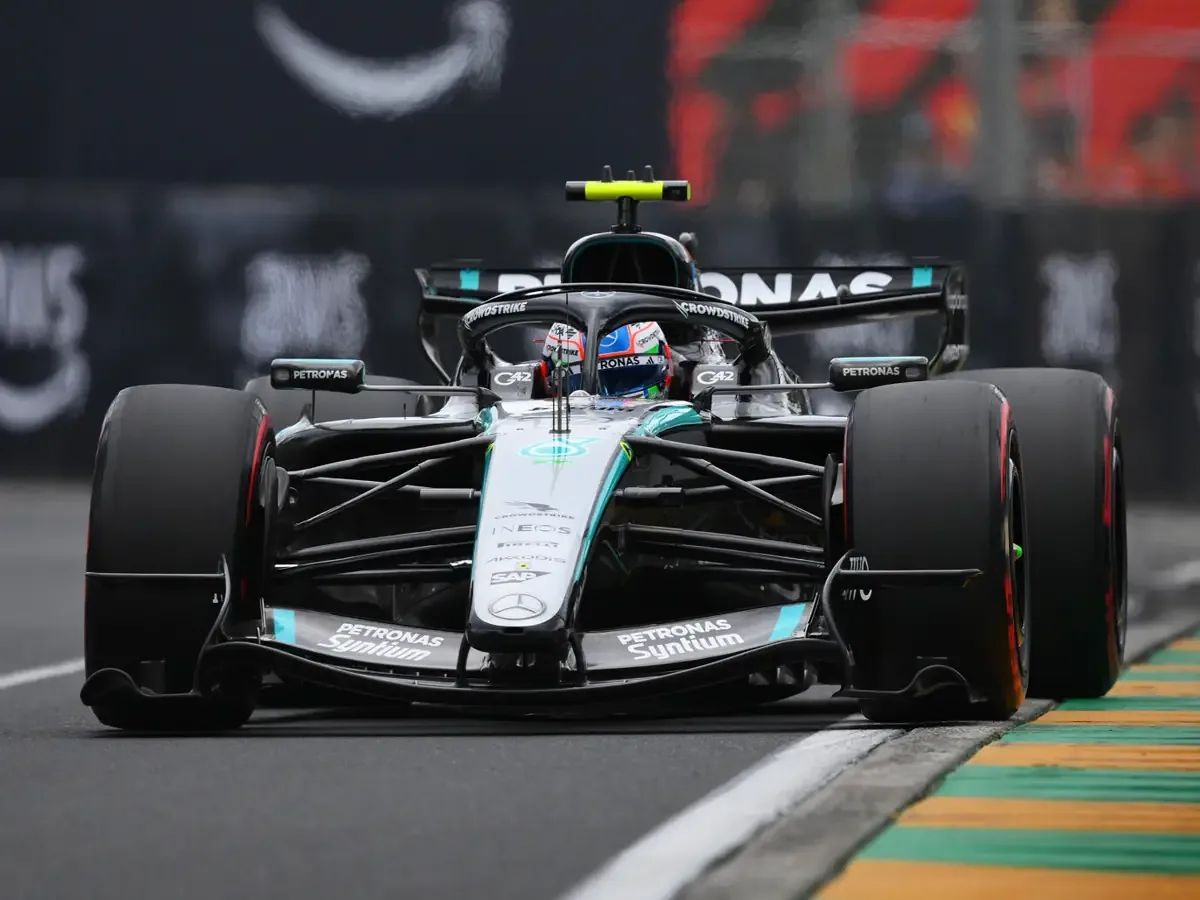
(Motorsport-Total.com) – Mercedes was the measure of all things at the 2026 Formula 1 season opener in Australia: George Russell secured victory ahead of his teammate Andrea Kimi Antonelli, and the subsequent data analysis impressively shows how superior the Silver Arrows were to the competition.
Read more Cadillac boss reveals: Andretti had investors who were not real
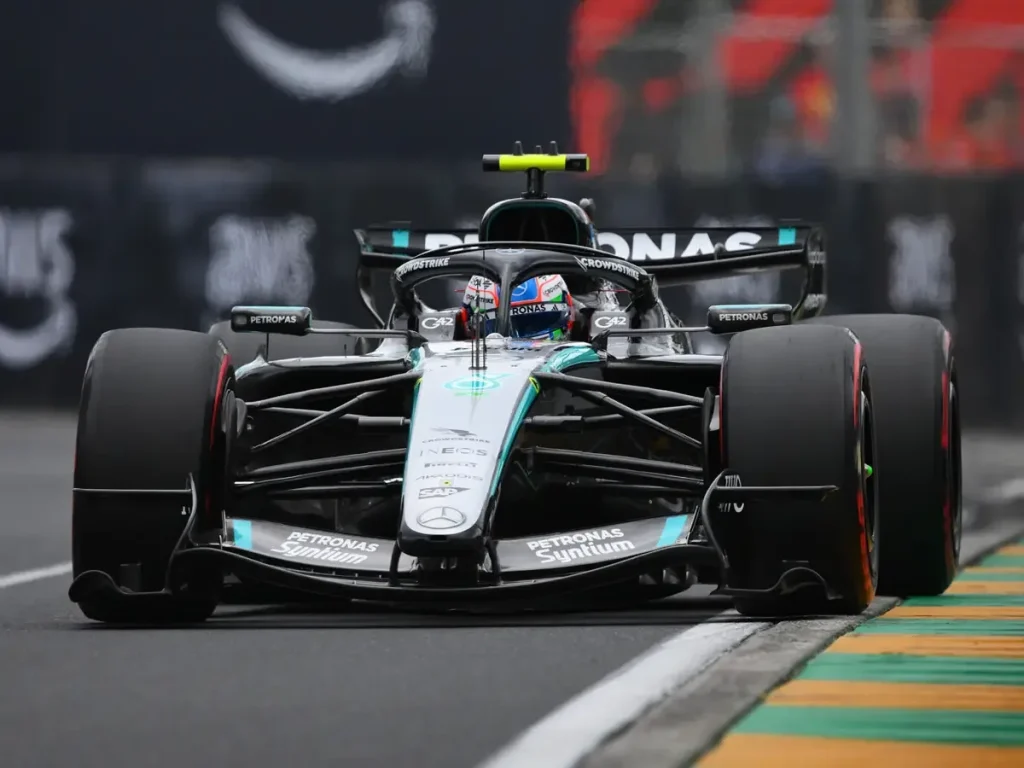
It is no secret that the Mercedes engine is strong. However, Mercedes’ dominance cannot be attributed solely to the new power unit, which caused heated discussions even before the start of the season, or the efficient energy management, but to a large extent also to the innovative chassis of the W17 E Performance.
The strength of the Silver Arrows was already evident in qualifying, when Russell took pole position with a lead of almost eight-tenths of a second. In the race, this picture changed very little: Ferrari was the only team that could keep up to some extent, while McLaren fell even further back due to several problems.
The crucial point is that this advantage is not due to a single factor, but encompasses several interconnected areas that reinforce each other. This is also the reason why McLaren’s gap is relatively large, even though the same Mercedes engine is used.
Mercedes W17 particularly strong in energy management
Of course, one must not forget that the Silver Arrows’ powertrain currently appears to offer a small advantage over its rivals – but that is only part of the story that currently makes Mercedes the biggest favorite for this year’s World Championship title.
On a lap in qualifying, it became clear: with only seven megajoules allowed by the FIA in Australia to avoid excessive lift-and-coast, it is not only the contribution of the internal combustion engine that is decisive, but also how energy is used and recovered.
This is the first major topic, because in this area Mercedes currently seems to enjoy an advantage over the competition, especially on fast tracks with few braking zones and when only little energy is available, as in Melbourne.
When the engine is turned up and the true qualities of the power unit become visible, the W17 flies, especially on the straights. Where significant power drops were still recorded on Friday, the loss of speed on Saturday was much lower and more linear, without Russell and Antonelli having to use excessive lift-and-coast or sacrifice other parts of the lap.
Internal combustion engine as important support
This suggests not only that Mercedes interpreted the energy management flawlessly on such a low-energy race track, but also that the internal combustion engine, especially when certain peak values are reached, can provide significant support.
This happens primarily by the combustion engine reducing the load on the MGU-K in the most sensitive areas and allowing the MGU-K to contribute to reducing turbo lag. On a fast track like Australia, the combination of these factors led to a near-perfect constellation.
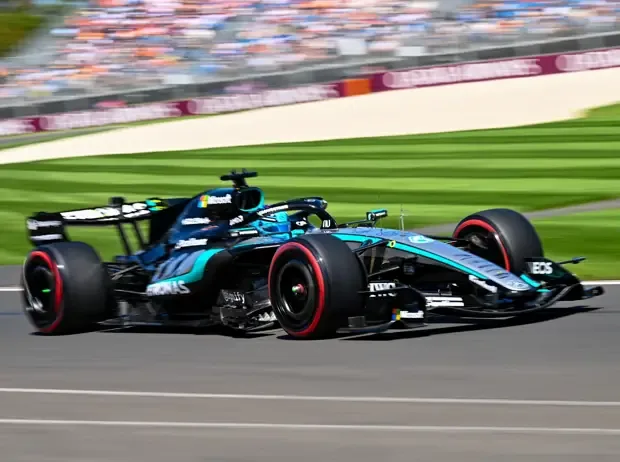
However, it should not be forgotten that Mercedes has been working on this powertrain for years, continuously developing its models and building a broader knowledge base than the customer teams, who ultimately receive a finished product.
Mercedes uses super-clipping more frequently
An interesting aspect concerns energy recovery: the W17 is less dependent on lift-and-coast, but rather uses super-clipping (Explained: The technical terms of the “new” Formula 1) with the rear wing open, allowing it to reach the braking zone faster.
Read more Max Verstappen reveals: Contact with Helmut Marko continues
This becomes relevant for two reasons and highlights another strength of the car. According to current regulations, the FIA allows energy recovery of up to 350 kW during braking or in phases where the accelerator pedal is not fully depressed, i.e., in medium-speed to slow corners or during lift-and-coast at the end of straights.
For safety reasons, however, the charging limit for super-clipping is restricted to 250 kW. This difference is anything but marginal and forces teams to carefully weigh up, from an energy management perspective, how and where recovery could be more advantageous.
The opener in Australia showed: while Ferrari apparently relies more on lift-and-coast to recover energy, the Silver Arrows focus instead on super-clipping as the preferred option, especially in qualifying.
Russell and Antonelli brake harder and longer
Having outlined these differences, one should also understand how they affect driving style: while higher charging values can be achieved with lift-and-coast, it takes some time to reach the full 350 kW.
This also means a different driving style: those who use a lot of lift-and-coast enter corners more slowly and also have to brake less there. Apart from other qualities of the SF-26, this is one reason why Ferrari was consistently among the fastest in terms of mid-corner speed in the fast chicane in Melbourne.
Because while the Mercedes was still in the braking phase because Russell and Antonelli braked deep into the corner, Ferrari was already close to the acceleration phase and was thus able to maintain a higher speed through the corner.
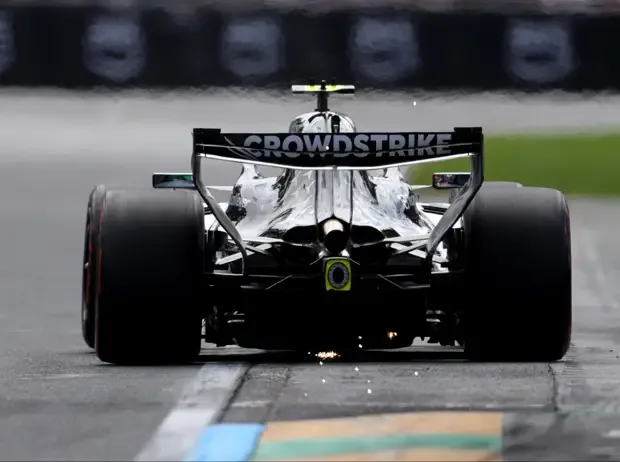
The W17 works the other way around: the tendency is to rely more frequently on super-clipping and to extend the braking phase by braking deep into the corner, similar to last year. An approach that differs significantly from Ferrari.
Mercedes W17 works thanks to strong chassis
To maintain this approach while achieving good mid-corner speeds without understeer occurring, an effective chassis and good balance are required, which the Mercedes W17 apparently offers.
This topic was also highlighted by McLaren team principal Andrea Stella. He referred both to the gap in hybrid deployment, which is also related to different gearbox management and deployment philosophies, and to the fact that the MCL40 currently still lacks pure aerodynamic downforce.
Stella emphasizes that the W17 is stronger in corners than it initially appears. In combination, these elements reinforce Mercedes’ strengths on a track that likely showcases the W17’s qualities best.
The track in Shanghai, on the other hand, will present a different challenge: although there are long straights, fast, sweeping corners and numerous opportunities to recharge the battery do not make it one of the most energy-intensive tracks of the year. And then it will be seen whether the Mercedes advantage remains.
Read more Formula E boss criticizes new F1 path: «They are making a mistake»