(Motorsport-Total.com) – The cancellation of the Bahrain and Saudi Arabia Grands Prix in April 2026 due to the conflict in the Middle East has changed the Formula 1 calendar. The double cancellation has created a one-month racing break and at the same time caused numerous problems in reorganizing the second half of the season.
Read more 24h teammate understands Verstappen’s frustration with Formula 1
Because formally, the two events were never officially canceled by Formula 1. The racing series only stated that the races would not take place in April. It is therefore clear: the goal remains to make up the Grands Prix in Bahrain and Saudi Arabia later in the season.
Much will depend on the development and timing of the conflict in the Middle East, but several options remain on the table – also at the request of the respective promoters.
This was also confirmed by Liberty Media CEO Derek Chang, who stated at the recent shareholders’ meeting presenting the business figures that the Formula 1 leadership is working “day and night” to at least reschedule one of the two races.
Chang said: “We will act cautiously. It might be possible to reschedule a race towards the end of the season.”
Concrete scenarios for the race postponement
In the most optimistic scenario, one of the two races could be reinserted into the calendar between Baku and Singapore in September. Currently, this is considered the most concrete option, as it would not require profound changes to the calendar, even though it would mean three consecutive triple-headers in the final phase of the season – with additional strain on human and logistical levels.
Changes in the Formula 1 calendar in recent years
The situation becomes more complicated if both events are to be made up. From the end of October, Formula 1 moves to America, so there would be no room for an additional race in November.
It would be easier to attach a race to the end of the season when the World Championship returns to the Middle East anyway. But this solution also carries complications: contractually, Abu Dhabi must remain the last race of the season. To insert another Grand Prix, the finale would have to be postponed by a week, bringing the calendar even closer to the Christmas break.
It must also be considered that teams stay in the region for several days after the Abu Dhabi race to participate in a Pirelli test for data collection for 2027.
Formula 1 Quiz
In which year did BMW first enter Formula 1?
Test yourself now in the Formula 1 quiz and compare yourself with other users
The calendar would therefore not only be extended, but together with Las Vegas and Qatar, a series of four consecutive races would arise. An already extreme part of the season would become even more demanding, especially since not all team members can rotate. It is easy to understand why this option currently remains more in the background, even though the additional income for the teams is a strong argument.
What if the conflict is not resolved?
All this is based on the most favorable scenario, namely that the conflict will end soon. However, the situation remains extremely volatile, and it cannot be ruled out that even Qatar and Abu Dhabi at the end of the season could be in question if no international agreement is reached.
In this area, however, Formula 1 has already confirmed that it has contingency plans to prevent the total number of races on the calendar from dropping too much. Stefano Domenicali explained: “The deadlines or time windows change depending on whether we have to make up what was not raced in April or respond to what could happen at the end of November or beginning of December. We coordinate with teams and promoters because every decision has a domino effect.”
Read more Young TGP Hockenheimring: When Truck Racing Meets Festival Vibes
It’s all a question of logistics
But even more than the time factor, the organizational question is significantly more complex than it appears at first glance. Because as a result of the conflict, material from teams and Pirelli is still in Bahrain.
The bigger problem, however, is that the Middle East is a central logistical hub for all teams. Large parts of the material transports for Asian race weekends usually run via Dubai or Doha. Alternative solutions had to be found already for the Japanese Grand Prix.
Formula 1 races that had to be canceled
Precisely for this reason, Singapore is considered an organizationally particularly difficult stop in the second half of the season – both for material and personnel. The uncertainty about the further development of the conflict forces the teams to reorganize all transport routes and develop alternative solutions that ensure safety and efficiency.
Material transport falls under the budget cap
Efficiency is the decisive keyword here. While expenses for hotels, flights, taxis, or buses for personnel do not fall under the budget cap, this does not apply to material transport: these costs directly affect the teams’ spending limit.
The conflict has already caused costs to rise significantly, and alternative transshipment points increase expenses further. Smaller teams are particularly affected.
Haas chief engineer Hoady Nidd explained: “For smaller teams, the increased transport costs have a greater impact – not necessarily because our expenses are higher than those of large teams, but because they make up a larger share of our budget. Our logistics team is working intensively on solutions.” The racing team is considering air freight but is also looking at sea transport.
These factors illustrate why even a make-up race between Baku and Singapore, despite several months’ lead time, would be anything but simple organizationally. Because each team has various material packages that are shipped by sea freight depending on the destination. With the reintroduction of an additional race, this planning would have to be comprehensively revised.
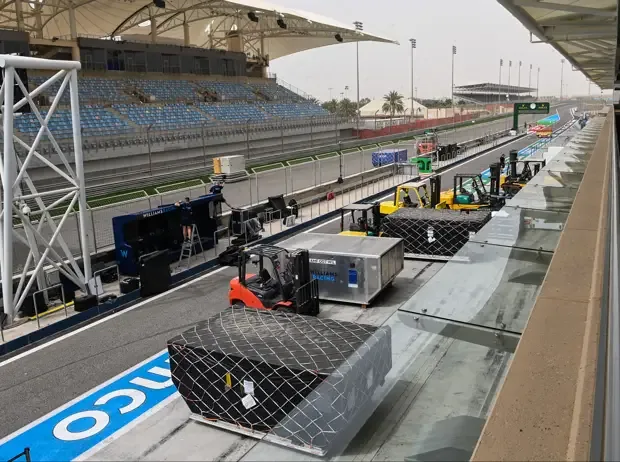
A challenge that could be managed with several months’ lead time but becomes significantly more complicated as long as reliable framework conditions are lacking. Added to this is the problem of material transfer between individual Grands Prix. For sustainability reasons, there are precise regulations for transport routes and shipping methods, so many teams’ containers – including chassis – returned to the factory after the Japanese Grand Prix sometimes with more than a week’s delay.
The human aspect: more than just a stress test
Finally, there is another, much more sensitive factor: the human burden. Top teams usually have larger personnel resources and can rotate more frequently. The situation is different for smaller teams: fewer resources mean more difficult rotations, and an additional race would significantly increase workload and stress.
Moreover, not all team members can be rotated. While systems have been created in recent years for certain roles such as mechanics to cope with the growing number of races, this does not apply to driver-specific engineers, specialized technicians, sporting directors, and other key personnel at the track.
And: Another race would mean that the second half of the season grows to twelve events in just sixteen weeks. For many senior team members, this would mean almost four months without a real break away from home – a feat whose technical and human strain can hardly be overestimated.
Read more Without asshole gene to the World Cup title? Oscar Piastri wants to be a «real racer»