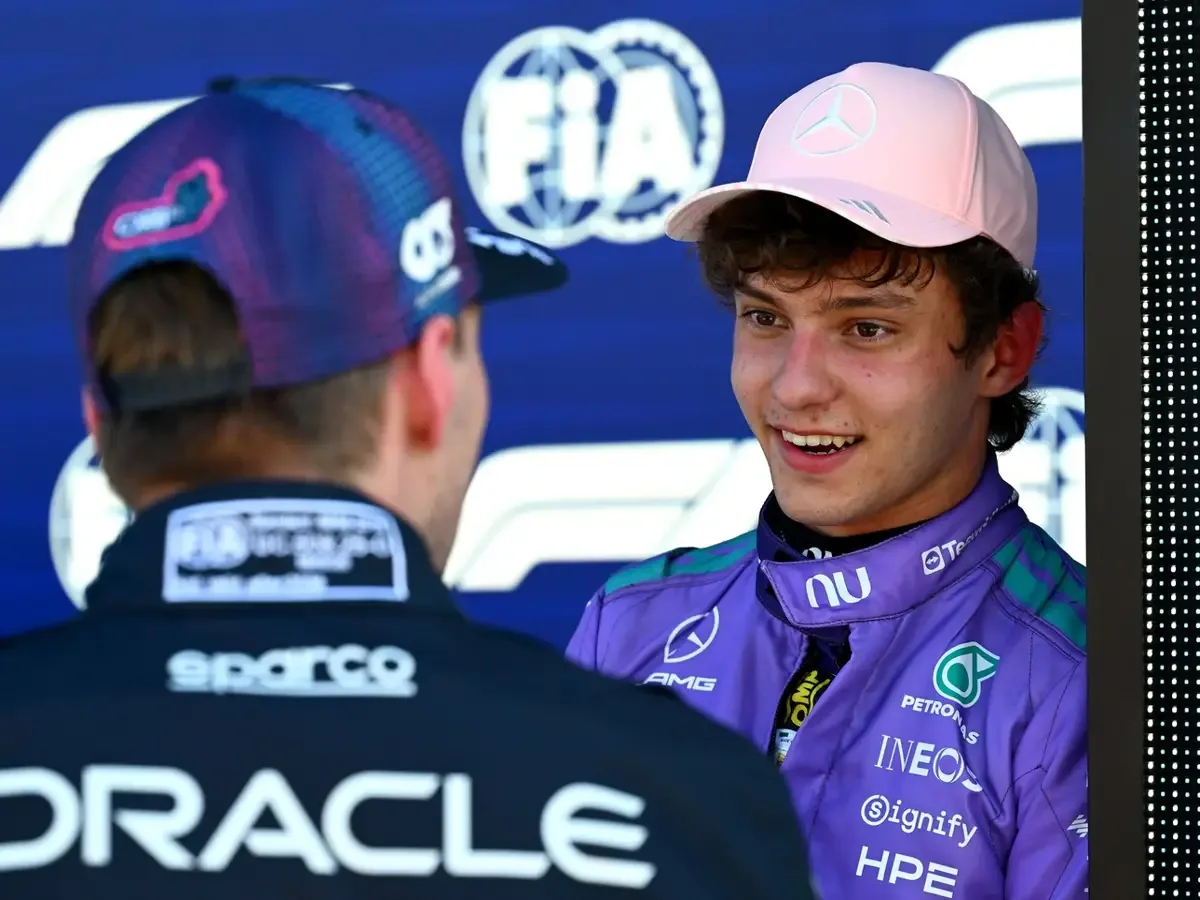
(Motorsport-Total.com) – Kimi Antonelli has added another chapter to his reputation as an outstandingly fast learner in Formula 1 by leading Mercedes back to the top in qualifying for the Miami Grand Prix.
Read more «Have complicated it»: Mercedes worries before the race start in Miami
On Friday, in qualifying for the F1 Sprint, Antonelli’s deficit of 0.222 seconds to Lando Norris’s McLaren was explained by a disrupted practice session caused by a power unit problem that prevented him from running on the soft tires he would use in the final segment of the sprint qualifying. He reported that his car “came to life” on the softs, but the lost track time showed in a few tenths left behind.
Easy to dismiss as an excuse. But a day later, after he had comfortably won the sprint, Norris was actually slower in Q3 than in the final shootout for the sprint starting grid—and was beaten not only by Antonelli but also by Max Verstappen and Charles Leclerc.
Norris: McLaren boxed above weight in the sprint
“It’s not that I think we did a bad job,” says Norris. “I just think others did a pretty bad job yesterday, and today they just did the job they were supposed to do. And I already said yesterday: Mercedes was just as fast as us.”
“If you look at the GPS data from Ferrari and Red Bull, there are many places where they are faster than us. So I think we just did a very, very good job yesterday, and I did a good job yesterday, and we did a good job this morning to win the race. Today is probably just a little reality check, but more where we belong and where we honestly should be.”
Why deployment in Miami is so important
Miami is one of those tracks where the rule applies: once time is lost, it is lost—drivers find it hard to make up early lost lap time. This is due both to the layout and the low-grip asphalt: if you lose time in the twisty first sector, the temptation is great to push more elsewhere—which often leads to further small slides and mistakes that increase the losses.
The latest generation of Formula 1 cars has rather reduced than increased the possibilities to regain time in the classic sections, as they have to hit turn 11 extremely precisely, where differences could still be made before. There are similarities here with turn 9 at Melbourne’s Albert Park.
Also, reducing electric power at the end of the long back straight reduces the chances to make differences. Added to this is the tendency of the front tires to lose temperature on the straights, increasing the tendency to lock up at the end of these straights.
What could make the difference, however, were different strategies in the use of electric energy over the lap. Even if this is not necessarily a topic that excites fans of older generations.
And then there is the heat. With ambient temperatures around 34 degrees Celsius, tire management—a well-known contentious issue that has so far been overshadowed this season by discussions about the new rules—became a factor again, especially when accelerating out of slow corners.
Sector 1 in analysis
Antonelli’s first Q3 lap in 1:27.798 minutes put him about three tenths ahead of the times set shortly before by Leclerc and Verstappen. When he went out again to hunt times, however, he overdid it and had to abort the lap—while Verstappen was briefly on pole pace. A look at the data explains why.
“On Friday, I had a small problem with deployment on the last lap in SQ3,” says Antonelli. “So we definitely maximized that better today. We shifted the deployment during the lap to find the best compromise. And it definitely makes a difference. It’s not easy to understand where the best spots are.”
“Even on short straights, you sometimes underestimate how much you can gain by using a bit more energy. That definitely helped. And the team did an outstanding job in this area.”
Read more Glock explains Verstappen magic: Why Hadjar is suddenly without a chance
At the start of their fastest laps, Verstappen was up to nine km/h faster on the start-finish straight—probably because he used a bit more electric energy. He also drove in a higher gear. This gave him an advantage of 0.16 seconds between turns 1 and 2.
But Antonelli had to lift less in the quick direction changes of turns 2 and 3. This brought him back on Verstappen, and what then brought a clear advantage was a significantly higher speed profile: on the way to turn 4, Antonelli reached 289 km/h, while Verstappen stagnated at 267 km/h.
This gave Antonelli a lead of around three tenths at the end of the second sector, although Verstappen was able to reduce this somewhat in the meantime because he lifted off later before turn 6. Antonelli accelerated earlier out of turn 8 and restored the balance.
Sector 2 in analysis
In the furious second sector, Verstappen made up most of his deficit—again mainly thanks to deployment. On the slightly curved section towards turns 9 and 10, the gap remained stable, but when the track straightened out, Antonelli paid for having used more electric energy in the first sector. His top speed began to drop earlier.
Verstappen’s pace also dropped, from 344 to 327 km/h, before he went into so-called superclipping. The decisive difference, however, was that his pace dropped significantly later and more gently—and the superclipping only started after Antonelli’s. This is shown by the fact that the speed curves of both cars at full throttle bend sharply downwards.
Verstappen continued to nibble away at the deficit in the technically demanding section at the end of the second sector. He approached turn 13 less aggressively, which allowed him to stay on full throttle longer and carry more speed through turns 14 and 15—the tricky chicane under the Florida Turnpike bridge.
But although this earned him the purple second sector and almost parity, Antonelli was faster again in the short section between turns 15 and 16. Also on the following straight.
Sector 3 in analysis
In the third sector, Red Bull and Mercedes were initially level when accelerating onto the back straight. But Antonelli was able to use the electric energy a bit longer and maintained a minimal top speed advantage even as the power faded. Verstappen’s approach into the hairpin at turn 17—lifting and braking later—resulted in a slightly higher speed on entry but cost him time on exit. Thus, Antonelli was able to extend his lead to 0.166 seconds at the finish.
George Russell, fifth, was 0.399 seconds behind his teammate and attributed this to his difficulties with this track and its low grip level: “I made a mistake in my last corner, in my last lap, where I was about three tenths ahead,” he explains.
“A bit annoying, but this is a track I’ve always struggled with. Kimi was on pole last year, I was fifth. Today he’s on pole again and I’m fifth again. It’s just very slippery here, you drift a lot, the asphalt is hot. Similar to Brazil—Kimi was also more competitive than me there. I prefer tracks with a lot of grip, where tires and car are more connected to the asphalt. So yeah, I just want to get this weekend over with somehow.”
“In the end… well, he’s Kimi,” sums up team boss Toto Wolff. “He drives an incredible lap and then wants even more. And then it goes wrong again. But at least he doesn’t hit the wall, he just messes up the lap…”
Read more Next setback for Audi: Gabriel Bortoleto disqualified from the Sprint!