(Motorsport-Total.com) – For almost two decades, McLaren and Mercedes were partners in Formula 1, winning three drivers’ championships and narrowly missing out on several more. Then they underwent what Hollywood circles would probably call “conscious uncoupling” – a deliberate separation.
Read more Fernando Alonso blunt: Almost everything about the Aston Martin is bad!

In recent years, they have somewhat rekindled their relationship, winning another drivers’ championship and two constructors’ titles together, yet tensions between the two remain.
McLaren was one of several Mercedes customers who, at the start of this season, expressed their displeasure about a perceived “knowledge gap” between the factory team and its customers regarding how best to use the new power units.
In addition, CEO Zak Brown regularly criticized Mercedes’ plans to acquire a minority stake in the Alpine team, even going so far as to write to the FIA to make his concerns clear.
On Mercedes’ side, it is known that defeats against a customer in the later years of the ground-effect era regularly sent motorsport boss and co-owner Toto Wolff into a pure rage. At the Mercedes factory in Brackley, there will be some who breathe a sigh of relief that their dominance has been restored this season.
Therefore, there are voices in the Formula 1 paddock who believe that an opportunity lies in the next engine formula – meaning the period after 2030 and not the modifications to the current regulations, which have developed into ongoing political and technical chaos.
For the FIA and Formula 1, the desired outcome is a format where development is affordable enough for independent suppliers to compete, and engine manufacturers have less political influence.
Now, this will be a challenging process, and not just because it will require an extremely skillful political dance to clip the manufacturers’ claws while simultaneously keeping them engaged.
Currently, the power unit regulations are essentially determined by a committee comprising the six manufacturers who have signed the Concorde Agreement – including General Motors, even though they are a Ferrari customer for now.
Potential independents therefore have no significant voice. Theoretically, it is within the FIA’s power to decide what the technical formula will look like after the current Concorde Agreement expires in 2030, and President Mohammed Ben Sulayem has indeed made it unequivocally clear that he is prepared to do so.
However, this would be a very aggressive “take it or leave it” step that could alienate both the commercial rights holder and the manufacturers.
Brown Convinced by Planned Direction
Among the top teams, McLaren would likely benefit most from its own engine. And interestingly, Brown did not explicitly rule out this possibility when asked about power units for the post-2030 era during a media round in Monaco this weekend.
“Well, we are not a manufacturer,” he said. “So we’re not actually at the table in the power unit group. So now we just have to wait and see what the regulations look like. And if we find it interesting, we might take a look at it.”

“But until then, you basically know what we know about the future. So I think it would be a distraction at this point to do anything other than focus on where we are today and what we want to be in the future.”
“I think everything we hear from the president – V8, larger internal combustion engine, the right fuel, less battery, hybrid, sound – all of that sounds good. My technical capabilities don’t go much further than that. But I think that sounds like a great direction,” Brown said.
McLaren Has Its Own Engines
For its road sports cars, McLaren developed its own engines in partnership with Ricardo, the renowned engineering firm whose founder, Sir Harry Ricardo, had designed the cylinder heads for the fascinating, supercharged 135-degree V16 engine in Alfa Romeo’s pre-war Grand Prix racing car Type 162, which, however, never made it to a race.
Read more Fernando Alonso unsparing: Almost everything about the Aston Martin is bad!
Here lies a historical irony, for it was McLaren’s decision to enter series car production in the Ron Dennis era that caused the original split with Mercedes. Dennis had secured the partnership at the end of 1994, after desperately searching for a competitive engine supplier for two seasons following Honda’s withdrawal in 1992.
All McLaren World Champions in Formula 1
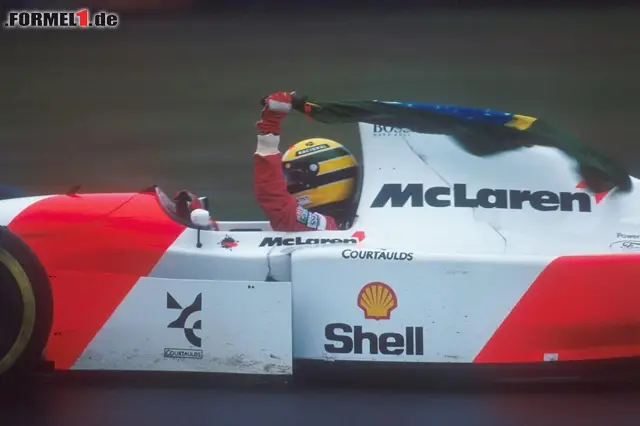
Mercedes had then quietly entered Formula 1 with Sauber, placing its logo on V10 engines built by Ilmor in Brixworth.
In the following years, the company expanded its involvement to acquire this firm and renamed it Mercedes-Benz High-Performance Powertrains (HPP). The engines were generally among the most powerful in Formula 1, though not always the most reliable.
Brown Announces Review
When Dennis decided to enter road car manufacturing – in direct competition with some, if not all, of Mercedes’ model ranges – Mercedes seized the opportunity that the Brawn team was for sale in 2009 to enter as a constructor itself. The end of the McLaren relationship was practically predetermined from that moment on.
In recent years, they have come back together, after another period where McLaren struggled to secure a competitive power unit deal. However, it is clearly a customer relationship, and the political fault lines are clearly visible.
Formula 1 Quiz
What was the fine McLaren was sentenced to after the 2007 espionage scandal?
Test yourself now in the Formula 1 quiz and compare yourself with other users
For the moment, however, McLaren has no viable alternative, which is why Brown expresses himself diplomatically: “I’m very happy with HPP,” he said. “They’ve been a great partner. We’ve won a couple of championships with them. Even though everyone said you can’t win a world championship with a customer engine, I think we’ve proven otherwise.”
“I think priority number one is to stay with Mercedes,” he says. “They are a great partner until the new regulations come out. Whenever new regulations appear, we will examine whether it is technically interesting. Does it make sense from a financial perspective? We will go through that process when the time comes. Sitting here now, we are extremely happy with Mercedes and expect to continue the collaboration.”
Opportunity and Risk for Both Sides
The future holds both clear opportunities and dangers for both sides of this relationship. As much as Mercedes has compelling logistical reasons to supply fewer teams, it would not look good to sever ties with its most successful customer.
Their brand will still be associated with winning the Constructors’ titles in 2024 and 2025, even if they didn’t achieve them with their own factory team. Wolff is smart enough not to let pride triumph over business sense.
For McLaren, building its own engine would be a technical and commercial risk. Money may be less of an issue as we head into an era where teams are billion-dollar franchises, but the challenge of building a competitive power unit depends on the final form of the regulations after 2030. The barriers to entry could ultimately prove too high.
Memories of Earlier Times in Monaco
A fitting reminder of this came last Thursday in Monaco, when Mika Häkkinen took to the track to mark the 60th anniversary of the team’s Grand Prix debut with the M2B, McLaren’s first Formula 1 car. Mika, mind you, never fully pressed the accelerator.

In 1966, when Formula 1 returned to more power with three-liter engines, brand founder Bruce McLaren bought a handful of Ford Indy V8 engines, hoping to downsize them from 4.2 liters.
But neither the efforts of an external engineering firm nor McLaren’s in-house guru Gary Knutson could make a success of it. Nevertheless, they made a magnificent sound. But that didn’t bring any trophies then, and it won’t in 2031 either.
Read more Kimi Antonelli exclusive: The underdog role doesn’t bother me