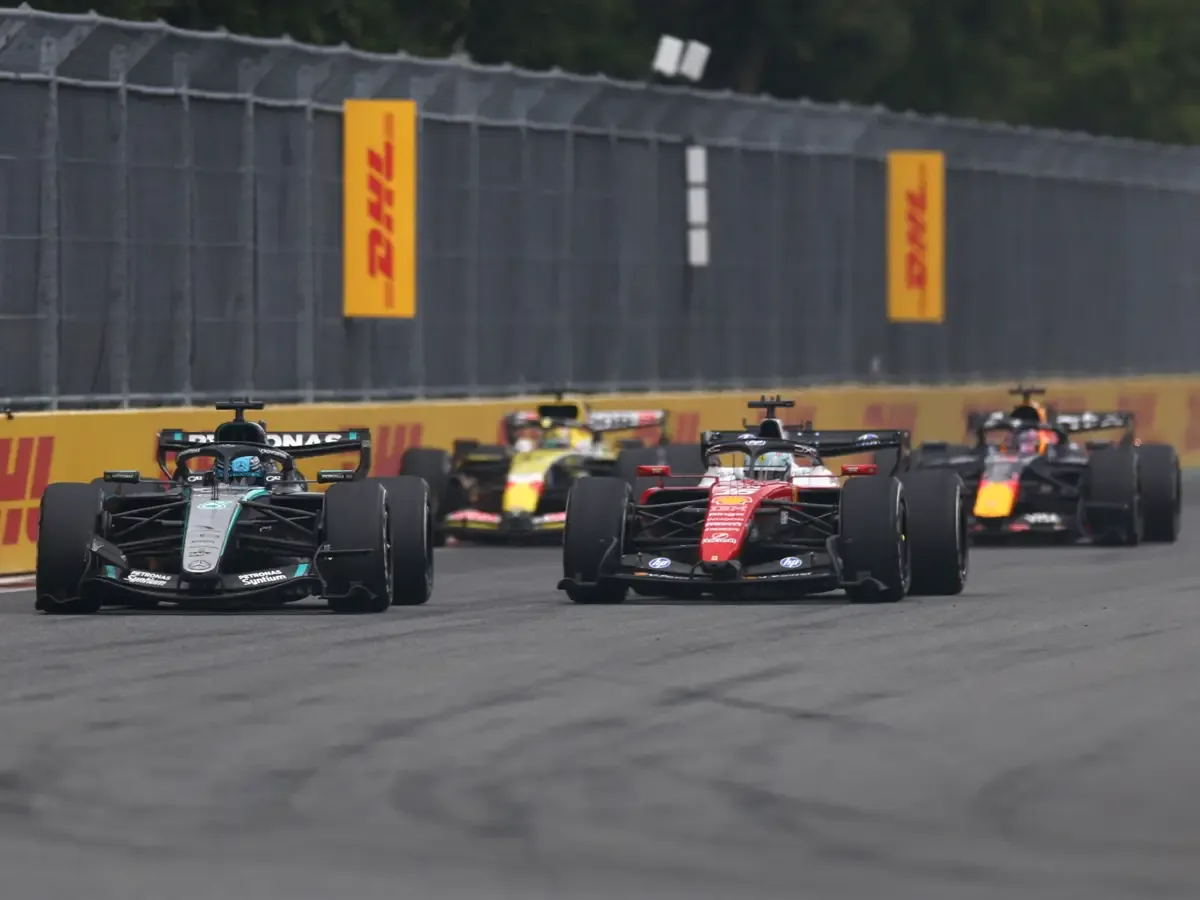
(Motorsport-Total.com) – Formula 1 made the first adjustments to the regulations during the five-week break between Japan and Miami to curb the controversial “Jo-Jo Racing.” Although there were significantly fewer “artificial” overtaking maneuvers in Sunday’s race, the hope for a sustainable solution apparently proves to be misguided.
Read more Formula 1 Technology: Alpine foregoes innovative folding wing
“In my opinion, the battles themselves have not changed massively,” says Ferrari driver Charles Leclerc, who does not primarily see the cause in the rule change. “I think the fact that it was so warm caused the tires to overheat quite quickly behind another car.”
“And that made it very difficult for me to be closer than in the first two or three races. So today it probably depends a bit more on that, but let’s see,” adds the Monegasque, who at least admits that the racing has “improved a little.”
Nevertheless, Leclerc points out a crucial point: In the first three races of the season, the impression prevailed that the new cars made it easier to follow each other through the corners, at least compared to the previous ground-effect cars.
But in Miami, both the track layout and the high ambient temperatures made following again a problem. The drivers had to carefully manage tire temperatures, especially on the rear axle, because several corner exits demanded a high level of traction.
The “DRS train” also returns in Miami
Engine temperatures also shot up as soon as the cars drove closer together. Additionally, the track layout created a real funnel effect regarding how and where teams or drivers released their available energy.
There was some leeway to use a bit more power in the first sector and on the start-finish straight, but ultimately everything came down to the decision to either carry extra top speed between corners 10 and 11 or on the back straight. That was exactly the key to the “optimal lap.”
Read more TV ratings Suzuka and Miami: Sky numbers on a roller coaster
Several drivers also commented on the limited effectiveness of the new overtake mode, which unlocks an additional half megajoule of usable energy when a car is within one second of the car ahead. But as soon as multiple vehicles were simultaneously within this window, the familiar “DRS train” from previous years returned.
“Everything is a bit better,” says Carlos Sainz nonetheless. “I think we just need to find a solution when the car in front is also in overtake mode. Overtaking is impossible. I think it is very similar to the DRS train. Maybe we could find something. The [Jo-Jo] racing was never really the problem of this regulation.”
“Jo-Jo Racing” will return in summer
It would be premature to claim that Formula 1 has finally gotten rid of the “artificial” overtaking maneuvers. Rather, they seem to be taking a break until the current race calendar reaches tracks again where layout and conditions offer more strategic deployment options.
However, this point is likely to be reached only in summer. “I would say that Montreal will be more difficult to overtake than here,” says George Russell. “Because there you have two clear straights where you will use all your energy. And all drivers will apply the same strategy.”
“While on tracks like Melbourne or maybe Silverstone, where you can deploy energy at different points, you will probably see a bit more of this Jo-Jo racing again. But Montreal will, I think, probably be a challenge again with the current regulations.”
Read more Formula 1 Technology: What is behind the new Red Bull sidepod?