(Motorsport-Total.com) – With the new Formula 1 power unit regulations from 2026, the FIA introduces a new tool: ADUO – “Additional Development and Upgrade Opportunities”.
Read more Formula 1 Engines: Test Bench Times Increase from 2027
Behind the cumbersome term is a deliberately developed system that offers manufacturers with less powerful power units additional development opportunities without directly interfering with sporting balance.
The goal is clear: The FIA wants to prevent individual manufacturers from permanently losing touch early in the new power unit era. Especially with regard to new manufacturers like Audi and the fundamental technical changes of the 2026 power units, a closer competitive environment is to be created.
In short: It is about greater equality of opportunity between power unit manufacturers, without classic balance-of-performance measures such as additional weight or technical special rights.
How does ADUO differ from a Balance of Performance?
In racing series like the World Endurance Championship (WEC), Balance of Performance (BoP) is used to deliberately slow down the fastest cars to keep the field together. (More information on WEC BoP in this article!)
ADUO works the other way around: The reference manufacturer is not restricted, but the lagging manufacturers are given additional tools with which they must reduce the gap themselves. For this reason, the system is often described as a “reverse Balance of Performance”.
How exactly does ADUO work?
The FIA monitors the performance of all manufacturers between 2026 and 2030 in defined evaluation periods and creates a so-called ICE Performance Index. ADUO is therefore exclusively about the internal combustion engine (ICE), not the hybrid components.
The performance index consists of various parameters such as torque at the drive shaft, engine speed, MGU-K power, and their influence on lap time. The evaluation is based on real vehicle data, without retroactively factoring out external influences such as aerodynamics, cooling, or track conditions.
If a manufacturer’s internal combustion engine is at least two percent behind the best measured unit, it qualifies for ADUO and the FIA creates targeted development scope through financial rules.
Nikolas Tombazis, FIA Formula Sport Director, calls ADUO “a way to further develop your engine through a downward adjustment. It is not a cure-all and the FIA does not give away bonus points here. ADUO merely creates the scope to further develop your power unit within the technical regulations.”
How much additional money do manufacturers receive through ADUO?
Manufacturers who meet the ADUO criteria are allowed to use additional financial resources outside the regular budget cap for power units to carry out development work. The greater the deficit, the larger this budget scope.
With a deficit of two to four percent, up to around 2.5 million euros of additional development expenditure is possible. If the gap is between four and six percent, this value rises to around four million euros, with six to eight percent to around 5.4 million, and with eight to ten percent to around 6.8 million euros. Manufacturers with a deficit of more than ten percent may even invest up to around 9.4 million euros additionally.
For the 2026 season, there is also a special rule: Extremely lagging manufacturers may additionally bring forward up to 6.8 million euros from future budget periods.
Thus, ADUO remains a tool for cost relief and development facilitation but by no means replaces the necessity to ultimately build the best engine.
What do the evaluation periods look like exactly?
To evaluate ICE performance, the FIA divides each season into several analysis phases. For the 2026 season, three evaluation periods are planned. The first period includes, after a calendar-related adjustment, the races in Australia, China, Japan, Miami, and Canada. Originally, Bahrain and Saudi Arabia were part of this block. Geopolitical changes in the race calendar, however, made an adjustment necessary.
The second period extends from Monaco to Hungary, while the third phase covers the races from the Netherlands to Mexico.
Ten curious and interesting Formula 1 rules that almost no one knows
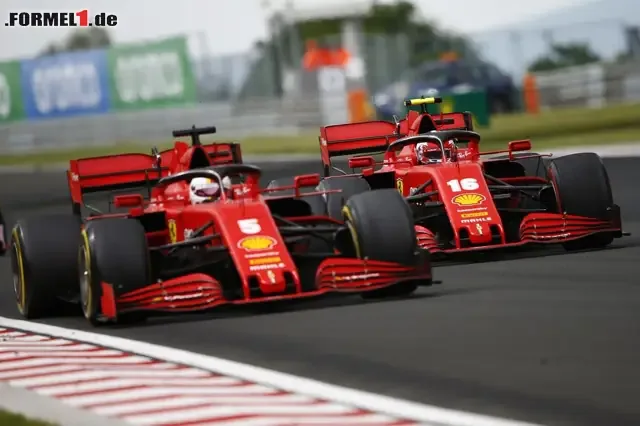
After each phase, the FIA recalculates the ICE Performance Index and informs the manufacturers of their classification no later than two weeks after the end of the respective evaluation period.
Qualified manufacturers then receive a separate notification about their additional budget releases and available homologation upgrades. Technical developments may already be introduced from the immediately following Grand Prix.
Read more So the drive from Red Bull/Ford became a big surprise
How do manufacturers specifically qualify for ADUO?
The allocation of additional homologation opportunities is based on clearly defined performance thresholds: Manufacturers whose internal combustion engine is between two and four percent behind the best unit receive one additional homologated upgrade for the current season and another upgrade for the following year. Manufacturers with a deficit of at least four percent receive two additional upgrades in the current year and two more in the following season.
However, there is an important restriction: Manufacturers who do not receive ADUO eligibility after the first two evaluation phases of a season cannot be newly admitted to the system in the final evaluation period of the same year. ADUO is intended to specifically address early performance deficits, not short-term later setbacks.
Can upgrades be “pooled” within a season?
No. ADUO homologation upgrades are not awarded multiple times within a season. An engine manufacturer receives them only once – namely the first time the FIA determines their eligibility.
However, over several years, the development scope can accumulate. For example, if a manufacturer receives additional upgrades for 2027 in 2026 and qualifies again in 2027, these development opportunities can be combined in the following year. In this way, significantly larger upgrade packages would be possible in certain cases, which increases the catch-up chances for permanently weaker manufacturers in the long term.
An example: After the 2026 Canadian Grand Prix, a manufacturer is less than four percent behind the most powerful power unit and therefore receives ADUO for two upgrades in 2026 and two more in 2027. However, if after period 1 of 2027 it is again less than four percent behind and receives ADUO for two upgrades in 2027 and two more in 2028, it may introduce a total of four upgrades in 2027: two from the ADUO allocation of 2026 and two from the ADUO allocation of 2027.
Can unused upgrades be carried over to the following season?
No. Upgrades intended for a specific season must be used within that season. Unused development opportunities expire without replacement. Only upgrades explicitly granted for the following year remain valid. The FIA deliberately prevents manufacturers from strategically accumulating larger development packages over several years.
Which components may be further developed within the framework of ADUO?
Although the performance evaluation exclusively considers the internal combustion engine, the technical development framework includes significantly more areas than just classic ICE components. Manufacturers may apply their additional upgrades, among other things, to turbochargers, exhaust systems, MGU-K, ERS components, cooling systems, sensors, control units, hydraulic systems, as well as certain operating fluids and ballast solutions.
Thus, ADUO remains a broadly based development mechanism that offers manufacturers diverse possibilities for performance optimization within the homologated power unit.
Why is ADUO strategically so important for Formula 1?
The new engine regulations from 2026 mark one of the biggest technical upheavals in modern Formula 1 history. New manufacturers, new fuel specifications, and a changed balance between internal combustion engine and electric power carry the risk of significant performance differences. Previous regulation changes – such as in 2014 – have shown how dominant manufacturers can shape the balance of power for years.
Formula 1 power units from Honda since 1964
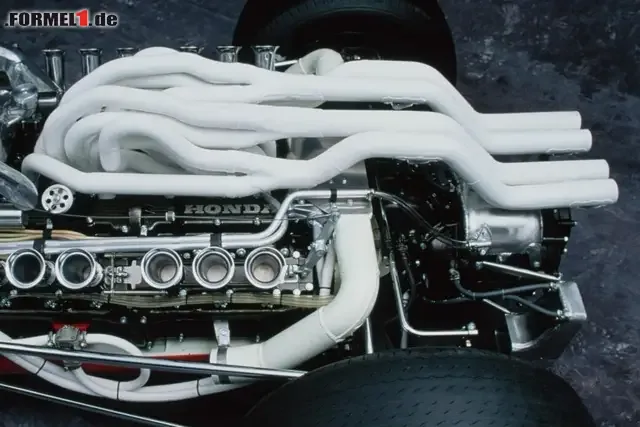
With ADUO, the FIA tries to minimize exactly this risk. Manufacturers with initial deficits should remain competitive without sacrificing the basic idea of technological competition. The system creates a middle ground between development freedom and cost discipline.
For motorsport enthusiasts, ADUO means an additional strategic level where homologation windows, development budgets, and technical catch-up races come more into focus. For beginners, the principle can be simply summarized: Those who are technically significantly behind in the new engine era get more opportunities to catch up – but in the end, the manufacturer who develops the best technical solution must still win.
Thus, from 2026, ADUO could become one of the most important regulatory tools to make the new era exciting, economically controllable, and as balanced as possible in sporting terms.
Which manufacturers could benefit?
Currently, Mercedes is considered the reference manufacturer in internal combustion engine performance. The most likely candidate for an ADUO classification is currently Honda, as Honda partner Aston Martin has so far only been able to finish a single race completely due to pronounced vibration problems with the Honda power unit.
Ferrari has also openly spoken about ADUO as an opportunity. Team principal Frederic Vasseur said in Shanghai that the system offers Ferrari a chance to “reduce the deficit”.
Audi team principal Mattia Binotto referred in Japan to “very long” development cycles and named 2030 as the brand’s target for regular title fights. But he also said: “Most of the deficit is due to the power unit. But that is not unexpected. We knew that would be our biggest challenge, and we have a plan on how we want to catch up.”
Mercedes team principal Toto Wolff, on the other hand, warns against false hopes: “The principle of ADUO is to help teams that are behind in the power unit to catch up – but not to overtake others.” Therefore, the FIA needs “absolute precision, clarity, and transparency” in every ADUO decision because ADUO can potentially have “big impacts on the balance of power and championship.”
Wolff continued: “It must be clear that tactical games have no place here. The FIA must act in the right spirit when applying ADUO.”
Read more Explained: This is why Russell does not have to worry yet in the World Cup duel