
(Motorsport-Total.com) – McLaren team principal Andrea Stella sees the main reason for his team’s gap to Mercedes in Formula 1 primarily in the aerodynamics of the current car. In qualifying in Shanghai, the Woking-based team had to settle for the third row of the grid. Oscar Piastri secured fifth place ahead of Lando Norris, with both losing around half a second to pole-setter Kimi Antonelli in the Mercedes.
Read more Renewed Verstappen criticism: Now Mercedes team principal Toto Wolff reacts clearly

Although clear progress is visible compared to the season opener in Melbourne, qualifying in China revealed the specific weaknesses of the MCL38. While the team in Australia was still heavily occupied with understanding the complex new Mercedes power unit, the focus is now increasingly back on the chassis.
The evaluation of GPS data shows that Piastri and Norris lost time to the Mercedes drivers and, to a lesser extent, to Ferrari, especially in Shanghai’s notorious first corner complex. A deficit compared to the competition is also evident in other medium-to-high downforce sections, such as the fast combination of turns 7 and 8 and the final left-hander.
Although the McLaren has strong traction and good acceleration out of slow corners, it is caught again by the Mercedes factory cars on the long back straight. Despite identical engine power from Mercedes, McLaren maintains a small lead over Ferrari, but this is significantly smaller than that of the factory team.
Focus shifts from engine to aerodynamics
Part of the gap can be explained by the fact that Mercedes still has an advantage in the use of energy recovery. According to Andrea Stella, however, the data points to a more profound problem.
“In Australia, 50 percent of the deficit to Mercedes was due to the use of the power unit and the other 50 percent to grip in the corners,” Stella explains. “I think we have closed the gap in power unit usage a bit, but as far as the corners are concerned, the gap is quite similar to Australia.”
The Italian attributes this to a lack of aerodynamic load. “There is, of course, grip that you generate by using the tires in the right window, but I think we all understand pretty well by now how to use these tires in qualifying. Therefore, qualifying is a good reference to see how large the deficit actually is from an aerodynamic perspective.”
Read more Driver ratings Shanghai: Razor-thin victory for Haas driver Oliver Bearman
No criticism of engine partner Mercedes
Stella also clarifies that there is no dissatisfaction within the team regarding the cooperation with Mercedes, even though both McLaren and the customer team Williams were surprised in Australia by the factory team’s advantage in engine usage.
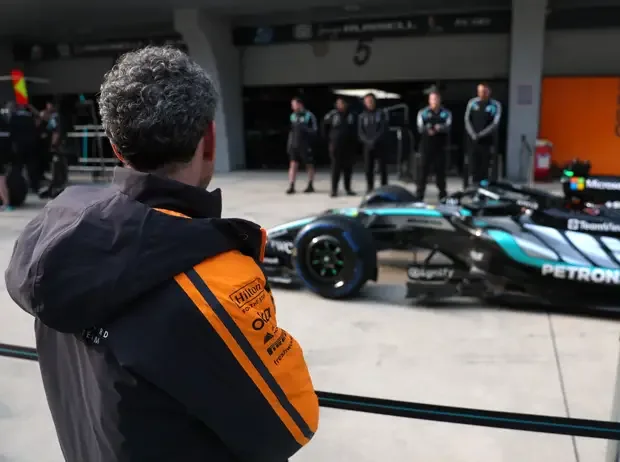
“I don’t think I’ve ever used a word like dissatisfaction, not even indirectly,” says the Italian. “It’s a very complex power unit. When you’re in the position of a customer team, you have to learn, and that’s completely natural.”
Stella emphasizes the uniqueness of the current power unit: “I can’t remember ever seeing anything comparable in power units in previous championships. You have to go through a learning curve, and we are grateful to Mercedes HPP for their support.”
Potential for the upcoming races
Stella sees it as a given that a factory team has an advantage through full integration and unrestricted data exchange. “It’s only fair that there is a small advantage from this point of view. We’re not complaining about it.”
The team principal is encouraged by the fact that McLaren can still extract more performance from the power unit with the current package, while improvements to the aerodynamics will only be realized through planned upgrades in May and beyond.
“We are in a better position than in Australia and can now extract more performance from the power unit. It looks like we still have reserves that we can mobilize. That’s positive because we can continue to improve lap times. There’s more to come in the next few races,” Stella promises.
Read more Data shows: The real problem for Ferrari against Mercedes