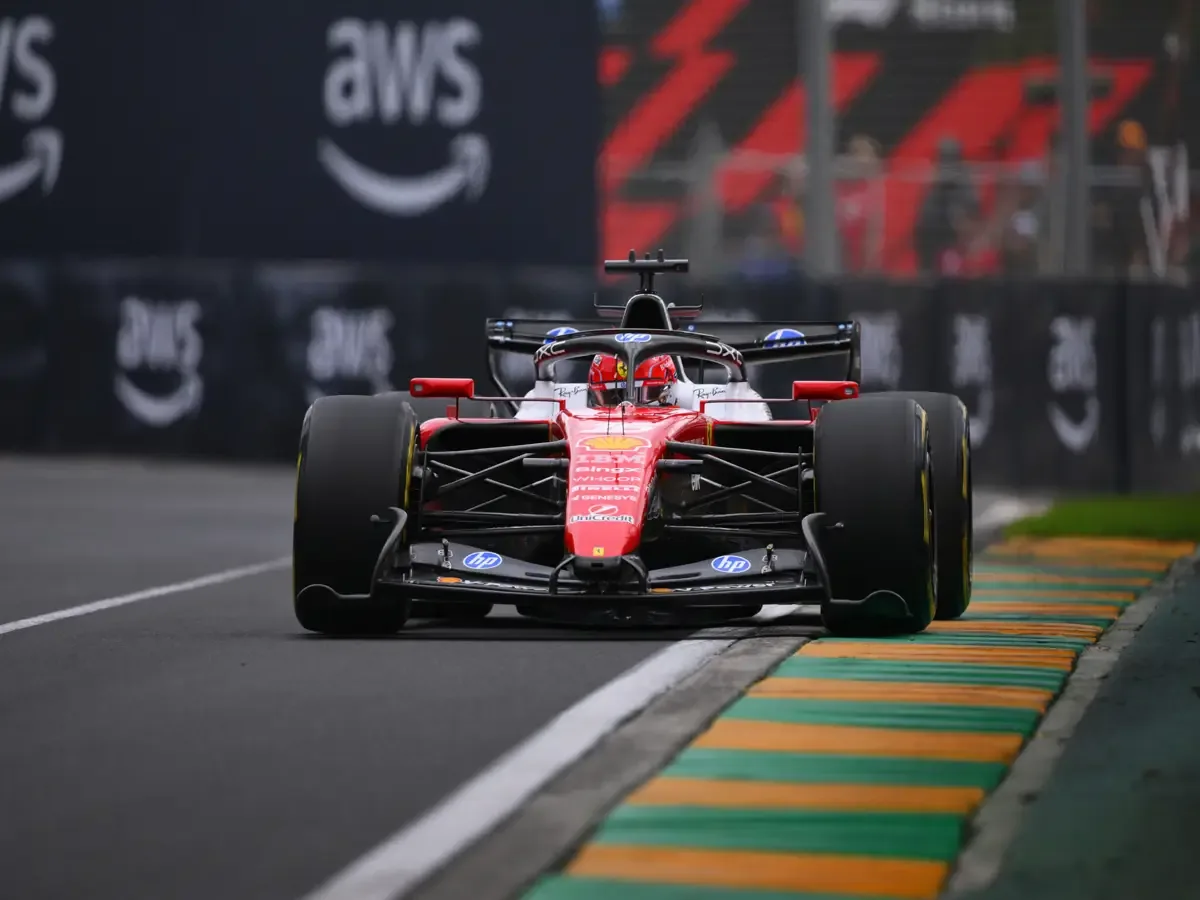
(Motorsport-Total.com) – Did Ferrari throw away the victory at the Australian Grand Prix by missing the chance to pit during the virtual safety car? Hardly – at least if you take a look at the data (see the video on the Formel1.de YouTube channel!). Because the fundamental problem is different: Ferrari was simply too slow for the Silver Arrows.
Read more Melbourne Driver Ratings: Podium for Arvid Lindblad on Formula 1 debut
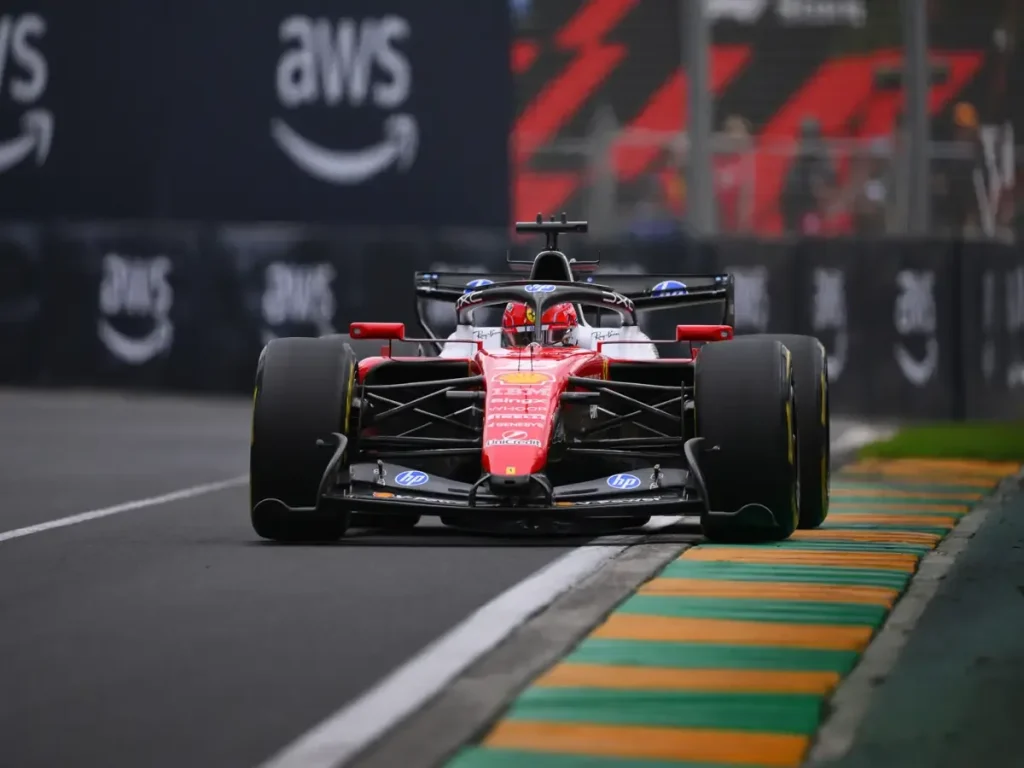
But first things first. When Isack Hadjar rolled to a stop in his Red Bull on lap 12, the virtual safety car was activated to recover the stationary vehicle. Normally, a pit stop in Melbourne costs around 20 seconds, but under a virtual safety car it is only about 10 seconds, as the cars on track are not allowed to drive at full speed.
From a strategic point of view, this is a great gift – and nothing unusual at the Australian race. The traditionally low tire wear usually leads to clear one-stop races. In 2023, practically the entire field switched from medium to hard tires as early as lap 8 after an accident by Alexander Albon triggered a safety car.
Due to the minimal wear, all drivers were able to drive through to the end of the race without any problems back then – at least that was the plan before another safety car came onto the track shortly before the end. Basically, however, the following applies: With the hard C3 tires, a complete race distance of 58 laps can usually be completed in Melbourne without any problems.
Why Ferrari’s explanations make no sense
After the race, Charles Leclerc was asked in the press conference whether he regretted the decision to stay on track. His answer: “I don’t regret it. It was a conscious decision. Since the first free practice, there has been at least one car that dropped out in every session. We knew that the probability was very high that it wouldn’t stop at a single virtual safety car.”
From a strategic point of view, however, this reasoning only makes limited sense. Because even if several virtual safety car phases occur, the person who pits first is generally at an advantage. He can perform the undercut and thus gain positions on the track.
Ferrari had apparently planned to use the second virtual safety car after Valtteri Bottas rolled to a stop shortly before the pit entry. But team boss Frederic Vasseur explains: “Then we were unlucky because the pit lane was closed.”
From a strategic perspective, however, the race was already decided at this point anyway. George Russell’s undercut was simply too strong. Even if Ferrari had reacted under the second virtual safety car, the Mercedes driver would have clearly remained in the lead and could have controlled the race.
Ferrari has not learned from the past
Even more surprising, however, is another attempt at an explanation for the strategy decision by team boss Frederic Vasseur: “We were also a bit surprised – I think Mercedes too – regarding the lifespan of the tires. I think we could have driven 300 laps today,” says the Frenchman after the race.
In other words: A pit stop as early as lap 12 apparently seemed too risky for Ferrari, as they were not sure whether the tires would last until the end. However, the long runs on Friday already indicated that wear at Albert Park would again be very low – very similar to previous years.
Formula 1 Quiz
How long did Ferrari have to wait for a constructors’ title before winning in 1999?
Test yourself now in the Formula 1 quiz and compare yourself with other users
And at the 2023 Australian Grand Prix, Ferrari was among the teams that switched from medium to hard tires as early as lap 8 and then basically drove to the finish without any problems. It should therefore have been hardly surprising that the hard tire traditionally has a very long lifespan at Albert Park. Although the tire construction for 2026 is new, in principle it still strongly resembles the models from previous years.
Read more Liam Lawson on battle with Sergio Perez: «As if he were fighting for the World Championship!»
Data: Ferrari kept artificially in the race by new boost
The fact that Ferrari did not stop at the first virtual safety car was definitely a strategic mistake. It would have been the only way to continue to annoy Mercedes. Because in a normal race course, the Scuderia would not have been able to beat the Silver Arrows.
The strategy-adjusted race pace data shows that the Mercedes was on average 0,64 seconds per lap faster than the Ferrari on race Sunday in Australia. A similar difference had already emerged in the long runs on Friday. Under normal circumstances, Mercedes could therefore have beaten Ferrari with almost any strategy – regardless of whether with an undercut or overcut.
Nevertheless, the race seemed much closer. The reason for this lies in the new overtake boost, which has replaced DRS. After every overtaking maneuver by George Russell – who was clearly faster than Charles Leclerc in the first stint – the counter-attack usually followed immediately on the next straight.
Because now Leclerc had the boost available, while Russell’s battery was empty. As a result, the Mercedes driver could never overtake decisively, pull away and play out his actual pace, as Leclerc was able to counter again and again. The duel thus seemed like exciting racing. However, looking at the data, the impression arises that Leclerc was kept artificially in the fight for the lead by the boost.
Final stint shows true Mercedes superiority
The actual pace of Mercedes only became apparent in the last section of the race – or rather, precisely not there. Both George Russell and his teammate Andrea Kimi Antonelli already stopped on lap 12 and nevertheless completed a one-stop strategy. Accordingly, their tires were significantly older than those of Ferrari at the end of the race.
Charles Leclerc only switched to the hard tires on lap 25, which meant his tires were 13 laps younger than those of the Mercedes drivers. Actually, this should have resulted in a clear pace advantage. Across the entire field, the average tire wear on the hard C3 tire was 0,071 seconds per lap. This results in a theoretical tire advantage of 0,923 seconds per lap for Leclerc.
But instead of closing in during the second stint, the gap to Mercedes remained almost constant despite the tire advantage. In his 33-lap second stint, Leclerc drove an average time of 1:23,068 minutes, while George Russell achieved an average lap of 1:23,099 minutes in the same period – so he was only minimally slower.
Purely mathematically, Ferrari should have been around 9 tenths per lap faster due to the tire delta. In fact, however, the gain was only 0,031 seconds per lap. Adjusted for tire age, Mercedes was thus almost nine tenths of a second per lap faster than Ferrari in the second stint.
Was there ever a fight for the victory?
The Australian Grand Prix seemed closer than it actually was. Ferrari’s rocket start initially put the Scuderia in a winning position, but this chance would have evaporated sooner or later anyway in a normal race course due to the inferior pace compared to Mercedes.
The energy boost kept Leclerc at the front of the race for a long time, while the failed strategy ultimately masked the actual problem: Ferrari simply lacked the pace to seriously beat Mercedes over a race distance.
Read more Formula 1 weather 2026: The current forecasts for Shanghai