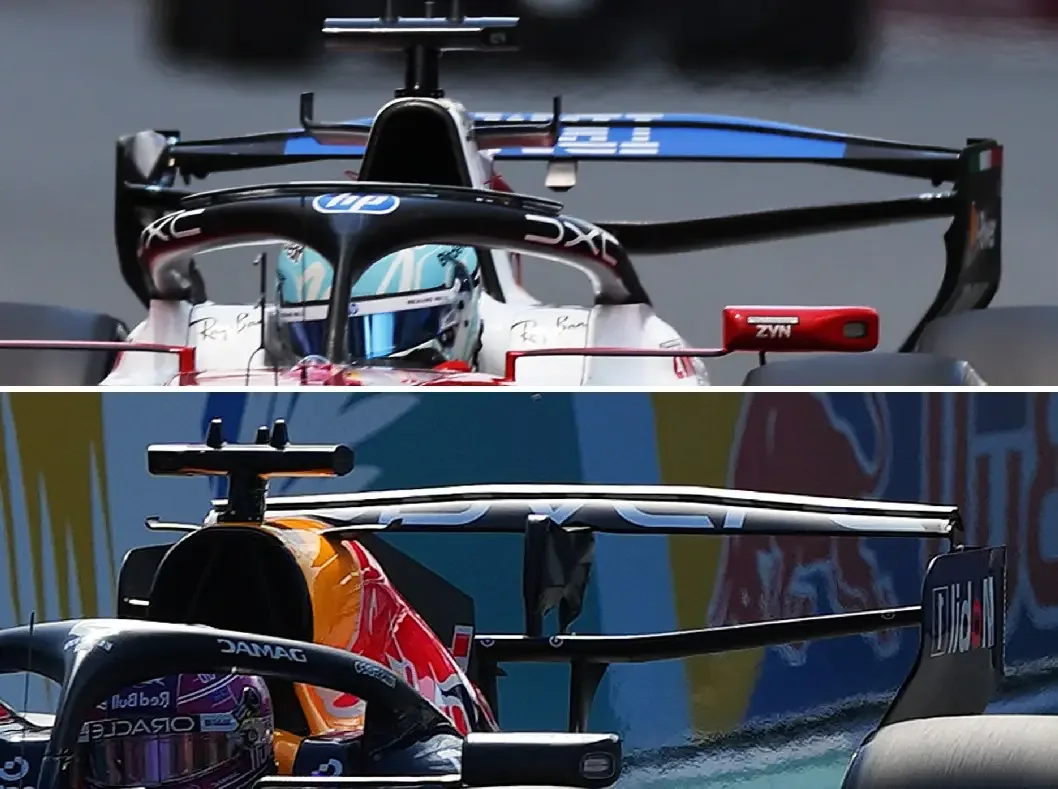
(Motorsport-Total.com) – Ferrari and Red Bull have presented different interpretations of the folding rear wing, each with its own advantages and disadvantages. While Ferrari focuses on maximum aerodynamic cleanliness and has developed a technically very complex solution for this, Red Bull concentrated more on efficiency, especially in the transition phase between open and closed states. An analysis.
Read more Fernando Alonso: New 10-Million Car with Special Extra
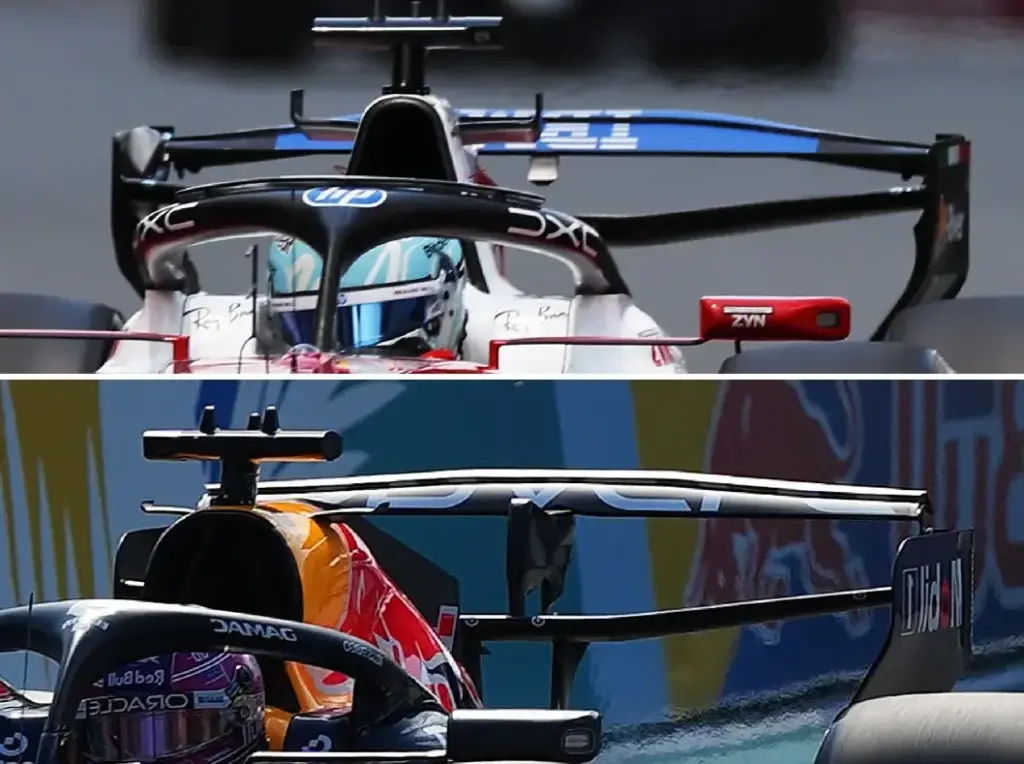
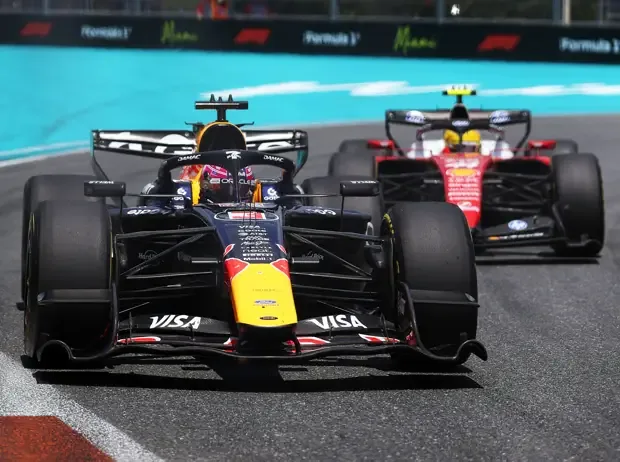
The duel between Red Bull and Ferrari is no longer limited to the track but is also fought with great intensity on a technical level. After initial tests on filming day in Silverstone, Red Bull launched its own version of the “Macarena” wing in Miami – a development that began as early as 2025, as technical director Pierre Wache explained in Miami.
But Red Bull was not the only team with new developments in Florida. Ferrari also brought an advanced version of its rear wing. Although both teams aim to reduce drag on the straights, their technical philosophies differ significantly.
The new regulations create new freedoms
This freedom for innovation was also made possible by the adjusted FIA regulations. While the opening of the previous Drag-Reduction System (DRS) was limited to 85 millimeters until last year, the current regulations allow significantly more leeway.
In the closed state, the flaps must still remain within a clearly defined regulatory box, but during the transition phase between positions, engineers enjoy much greater freedom. This opens up new possibilities to reduce drag and energy consumption more efficiently.
That neither Ferrari nor Red Bull had their solutions ready for the start of the season highlights the enormous technical complexity of a system where the flaps not only open but actually fold over and invert their position.
The Ferrari concept in detail
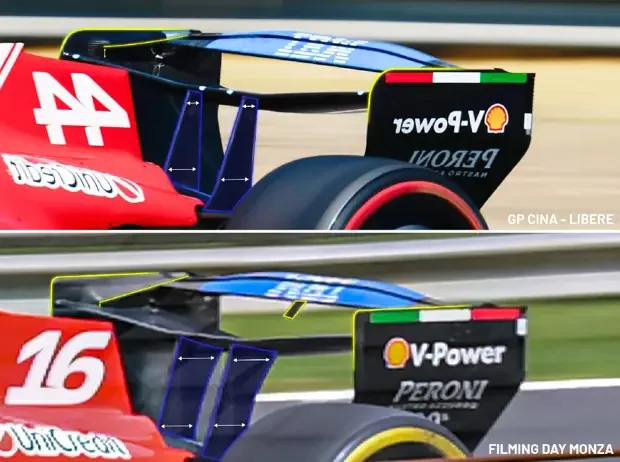
Ferrari apparently chose the technically more demanding path: unlike Red Bull, the movement is carried out via an actuator integrated into the rear wing endplate, which is considerably more complex both mechanically and structurally.
Here a fundamental difference between the two concepts already becomes apparent: each solution involves specific compromises, and each team had to decide where slight efficiency losses are acceptable.
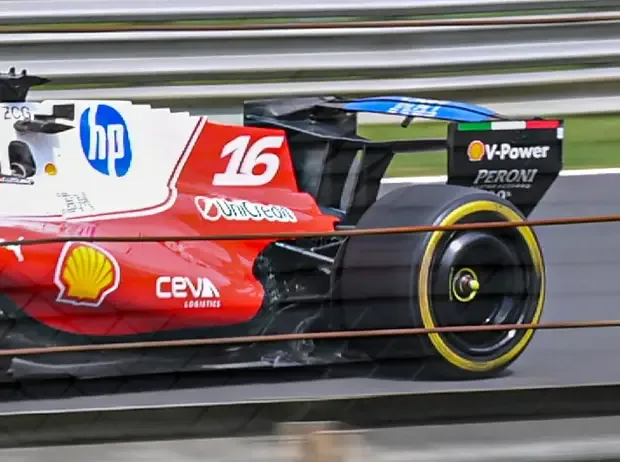
Ferrari accepted losses in the outer area of the wing to accommodate the rotation mechanism there. Accordingly, this area was revised in the latest version and adjusted in terms of position and angle of attack.
This decision enables the desired rotational movement and at the same time ensures a more aerodynamically clean overall structure, as a central actuator can be omitted.
The Red Bull concept in detail
Red Bull, on the other hand, relies exactly on this central mechanism, which offers mechanical advantages but can bring aerodynamic disadvantages. On the upper flap of the RB22, a small V-shaped profile is therefore visible in the central area, which serves to control efficiency losses that occur there when the wing is closed.
Especially in the open state, an as undisturbed airflow as possible is particularly crucial. A centrally placed, relatively massive actuator can affect the flow – an aspect to which Ferrari has paid great attention.
So why did Red Bull still choose this variant? On the one hand, it aerodynamically relieves both endplates, on the other hand, this decision is closely linked to the desired movement characteristics of the wing.
Read more ADUO: Questions and Answers about the Formula 1 «Catch-up Program»
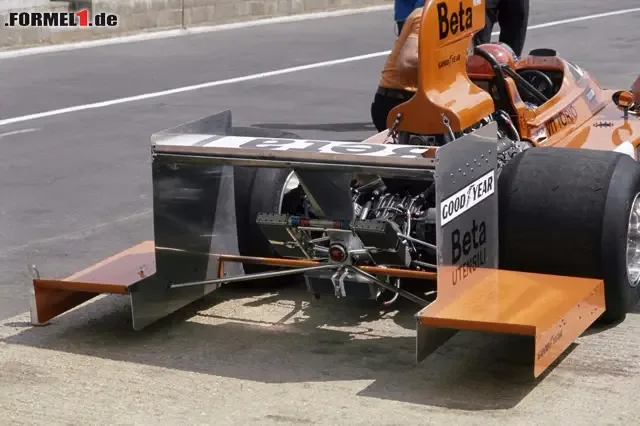
The ugliest ideas in Formula 1 history
In its end position, the folding wing of the RB22 creates a greater distance to the main profile than the Ferrari counterpart. This is also necessary because the flap must exceed the central actuator during the rotation process. To realize this movement sequence, the system requires not only a rotational movement but also an upward movement.
Exactly here, a central actuator offers decisive advantages: it allows easier force distribution over multiple attachment points, facilitates mechanical implementation, and saves weight since only a single system is required.
However, this causes aerodynamic losses in both the closed and open states. Nevertheless, this was the most direct way for Red Bull to achieve the desired functionality.
Further differences between Ferrari and Red Bull
These different approaches are also reflected in the design of the rotation joint. Ferrari uses a small pivot element integrated almost invisibly into the upper flap, which is specifically optimized for aerodynamic cleanliness.
Red Bull, on the other hand, had to develop a more complex solution: on the RB22, the pivot consists of two connected elements, one of which remains fixed while the other performs the rotational movement.
It is particularly important that the movable part also functions as a vertical support. Since the flap is positioned higher after the folding process, the construction must ensure additional stability – especially in an area that is aerodynamically heavily loaded and prone to the formation of air vortices. Ferrari has advantages in this area because the connection to the endplate is structurally easier to control.
How crucial the rotation time is
The biggest differences, however, show up in the transition phase between open and closed states.
A significant advantage of the Red Bull solution lies in the shorter rotation time. Since the movement path is shorter, the wing can react faster. This advantage is particularly relevant when closing the wing, i.e., when braking before corners, when maximum downforce must be available again as quickly as possible.
The difference is less significant during the opening process, as this usually occurs at already lower resistance. Nevertheless, Ferrari overall requires more time. Compared to a classic DR system, whose activation occurs almost immediately, both solutions are more complex.
In addition, the Red Bull wing temporarily takes on an almost vertical, concave position during the folding process, which could act aerodynamically like a small parachute. Ferrari, on the other hand, shows a underside with more flow-friendly edges in this phase.
When closing, however, this disadvantage reverses: Red Bull seems to generate full downforce again much faster. Thanks to faster rotation and the characteristic spoon shape of the flaps in the return movement, the reattachment of the airflows occurs more efficiently. For the drivers, this means more stability, especially in the first phase of the braking zone.
It is no coincidence that Ferrari drivers in Miami were among those who manually closed the wing a little earlier to regain the necessary level of rear stability in time. This underlines that Ferrari’s solution is aerodynamically extremely clean but potentially brings disadvantages in immediate drivability in practice.
Read more Explained: Why the Middle East cancellations are a logistical ordeal