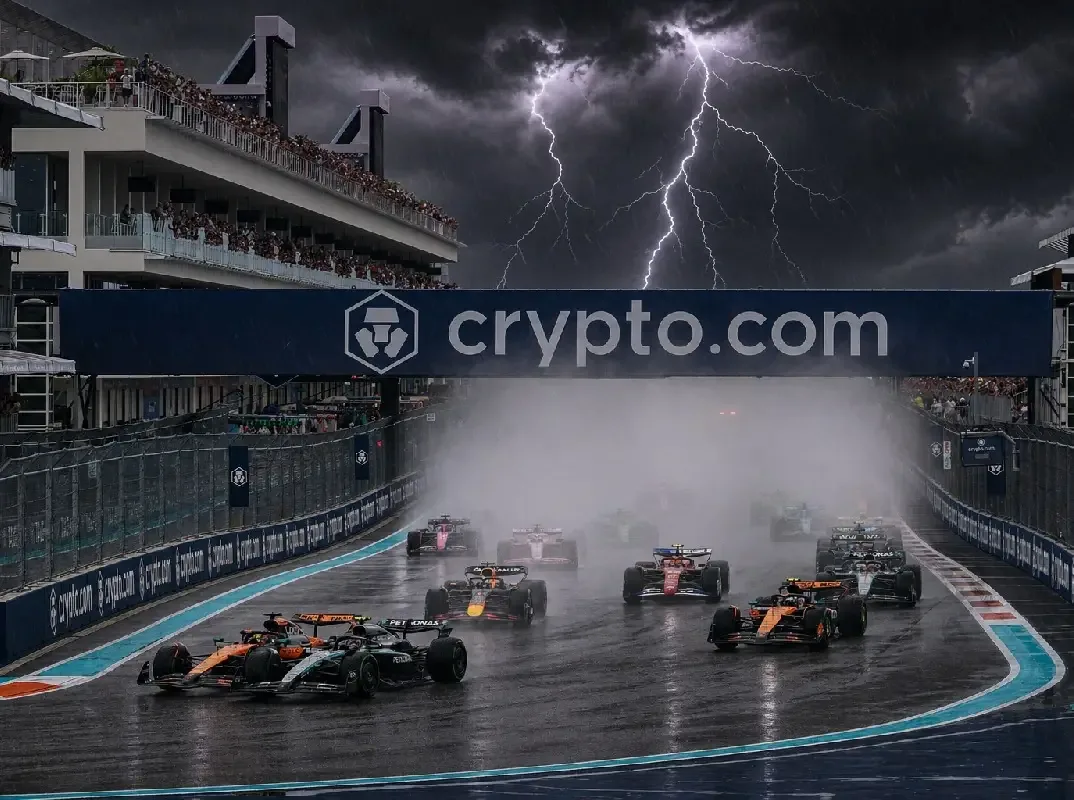
(Motorsport-Total.com) – “When it rains in Miami,” said Oscar Piastri on Thursday at the FIA press conference, “it really does.” Although it may seem premature to think about the prospect of rain so long before race day, there are good reasons for thorough preparation when considering the threatening weather forecast.
Read more Red Bull’s new summer can: Racing Bulls in Miami with a citrus look
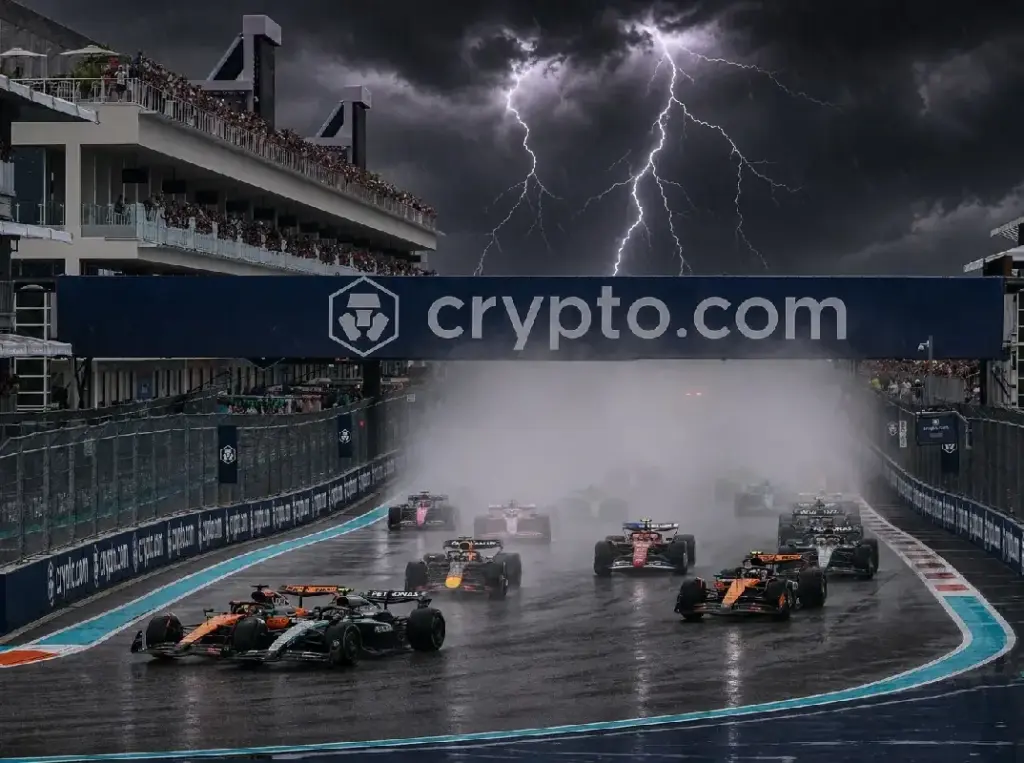
However, the most important question is whether the Grand Prix on Sunday can take place as scheduled at all. Because a significant thunderstorm risk is forecast for Sunday (the weather report for Miami), and that could put a stop to the action on the track.
Local public safety standards – based on OSHA regulations for on-site staff as well as the real risk of civil liability – practically oblige the organizers to suspend operations as soon as an imminent lightning risk exists in the region.
And even the FIA cannot override these.
The legal framework behind this is the widespread “30/30 rule,” which is firmly established in US sports associations from the NCAA downwards.
This means: If 30 seconds or less pass between a lightning flash and the following thunder, the storm is estimated to be 10 to 13 kilometers away. At this point, all outdoor activities must be stopped and shelter sought.
The standard also stipulates that operations may only resume after at least 30 minutes have passed since the last observed lightning or thunder.
For a venue the size of Hard Rock Stadium, where tens of thousands of spectators are spread over open areas, evacuation takes time. This means the decision to interrupt must be made before the actual threshold is reached.
Additionally: The rescue helicopter is not allowed to fly over the track during thunderstorms – and without operational clearance, there is no racing.
But it is not only local laws that must be observed in the event of thunderstorms: none of the current generation cars have yet raced under wet conditions.
Given the still immature state of the technical Formula 1 package for 2026, many unknowns remain – and several drivers have expressed concern about how the new cars will behave in wet conditions and the risk of large speed differentials in poor visibility.
Wet weather regulations were already embedded in the new rules but were strengthened by recent adjustments agreed before the Miami weekend.
These mainly concern the use of electrical energy, such as disabling the boost mode in the wet and capping power output at 250 kilowatts, as well as revisions to the Straightline Mode (SLM). Additionally, the allowable preheating temperature for intermediate tires was raised.
However, the press conferences on Thursday in Miami revealed that several drivers have reservations about the effectiveness of these measures.
The issue with the Straightline Mode
“There are some things, like the SLM in the wet only on the front axle, that I really don’t understand why we have it if it doesn’t significantly reduce drag,” says Carlos Sainz.
The principle of activating only the adjustable front wing flaps in Straightline Mode in the wet was discussed and evaluated in tests at the end of last year. However, since most tests took place under dry conditions in Bahrain, its effectiveness remains an unknown factor.
Straightline Mode normally involves flattening flaps on both the front and rear wings to reduce drag. The goal is to avoid wasting the limited electrical energy available to the cars over a lap. However, there were concerns that flattening both flaps in the wet would make the cars dangerously unstable.
It is already well known that the new cars are unpredictable with low grip. Pierre Gasly described his experiences driving in the wet when he ran his Alpine in January at Silverstone, perhaps in a bit too much detail:
Read more Cadillac shows Miami look: Formula 1 fans miss courage for creativity
“The tire temperature was 30 degrees, the wheels were still spinning in sixth gear,” he said. “After Maggotts and Becketts, I had to change my underwear every lap. It was the most extreme thing I have ever done in my life.”
Formula 1 fails: These rule changes were a flop
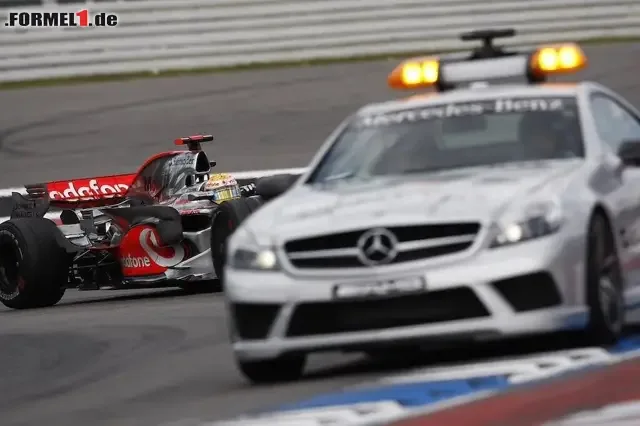
It is therefore understandable that the FIA wants to avoid worsening low grip conditions by destabilizing influences on the car.
But opinions on the effectiveness of partial activation obviously differ, and there are voices that see it only as another makeshift solution: Why not simply ban Straightline Mode in the wet altogether?
This is because the effects on the electrical energy balance are unknown, especially given the new 250-kilowatt per lap cap in the wet. Cornering speed, electrical recovery, and tire temperature are interdependent. If one of these factors drops, it can trigger a negative spiral affecting all areas.
Tire temperatures
If it rains on Sunday, it will be the first time the latest generation of intermediate tires is used under race conditions. Questions remain about expected performance and whether the increase in heating blanket temperatures will be sufficient.
Pirelli is still trying to develop an extreme wet tire (Full Wet) that is actually race-worthy. In recent seasons, its operating window was too far from the intermediate and its lifespan too short. Teams therefore avoid fitting it, because by the time the weather is bad enough to justify switching to Full Wets, a red flag usually follows immediately.
“I drove the car when we did the shakedown in Silverstone in the wet, and it was definitely very difficult,” says championship leader Kimi Antonelli. “Although now with the changes they have capped wet performance at 250 kilowatts and there is no boost – that is already a step forward in this regard.”
“But I think another big issue is that we need to increase the temperatures of the tire heating blankets for the rain. As they are now, they will probably be a bit too low for the conditions,” warns the Italian.
“It will definitely be very interesting because there are so many unknowns in the wet at the moment. Above all, no one has really used the intermediate tires yet, so we don’t know how it will feel, how much grip there will be, especially with the new regulations. And I think with this year’s cars it is a bit harder to get temperature into the tires.”
“So they could be tricky in the wet, and that’s why we probably need to increase the heating blanket temperatures to make it a bit better and easier on that side.”
Approach speeds
A related concern – especially on the Miami circuit, which tends to accumulate standing water – is the combination of poor visibility with different approach speeds. This is another area where electrical energy use has a strong influence.
“I think the strange thing about these cars in the wet is that at the end of the straight in wet conditions you could actually be much faster than in the dry,” says Charles Leclerc.
“Because you don’t have this power drop from the engine, because the batteries have much more… you don’t consume as much energy. So you have less power drop on the straights and arrive faster at the end of the straight,” says the Monegasque.
“You can get into difficult situations, especially when drivers run different power unit strategies. You have hardly any visibility. That’s the trick of these rules and something we need to find a way out of,” says the Ferrari driver.
“Because in the wet we are really just passengers. In the rain, it’s not about being brave or not. You stay flat on the throttle and hope no cars ahead are slower than you – and you just assume they are going the same speed.”
Read more Ferrari statistics do not matter to Leclerc: This is what he really wants to be remembered for!