(Motorsport-Total.com) – Max Verstappen says that he would have acted the same way as George Russell in the qualifying at Spielberg, but criticizes the race control’s handling of his accident and demands consequences if a driver ruins others’ laps.
Read more Esteban Ocon explains: This is how Haas wants to get rid of the car «nightmare»

The accident of the Red Bull driver in Austria last weekend caused a controversial scene. Verstappen had gone off in Q3 shortly before the end in turn 9 and caused a yellow flag.
Although Mercedes driver George Russell had to pass the accident site, the Briton took pole position because he was fast enough despite a lift to beat the best time set so far by Lewis Hamilton.
While teammate Kimi Antonelli aborted his lap, Russell recognized the situation and received praise for his cleverness: “That the driver then naturally optimizes that for himself, I find legitimate. I probably would have tried to do the same,” Verstappen admits before the Formula 1 race in Silverstone. “That’s just how it works.”
His criticism goes in another direction: “It should not even be allowed or possible to finish your lap like that,” he says.
Many drivers – unless they are named George Russell – were of the opinion after qualifying that a simple yellow flag was not sufficient for such an accident. Only in this way could Russell finish his lap at all. With red or double yellow, the lap would have been automatically invalid, with yellow a small lift at the right moment is enough to meet the requirements.
Is a different yellow flag rule needed?
Exactly this vague rule and its interpretation is repeatedly a subject of debate. I have had this discussion many times because I felt that some drivers operate quite close to this limit,” says Verstappen.
“I think we still don’t really have these things under control with a simple yellow flag. Like how much you have to slow down, or for example with double yellow. Because some slow down more than others. One does it right, the other wrong. It’s a very difficult topic,” says the Dutchman.
The most controversial Formula 1 collisions
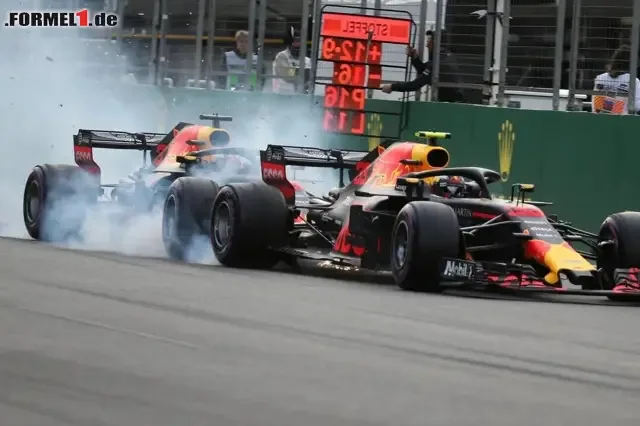
This also makes it difficult for race control: On the one hand, safety should of course be the top priority, but on the other hand, they do not want to unnecessarily take away drivers’ chances to finish their qualifying lap.
“The tendency is always to finish the lap if it is not the worst accident,” says Carlos Sainz, who in this case would still have imposed at least double yellow. Because: “When it comes to safety, even when trying to finish the lap, another Red Bull might break its rear wing and you crash at the same spot …”
In this context, another discussion is rekindled: Should a driver who ruins others’ laps – intentionally or unintentionally – be punished?
Tactical games in qualifying have happened often
The phenomenon is not new in Formula 1: Michael Schumacher’s parking maneuver in Rascasse 2006 initially secured him pole before it was revoked, and Nico Rosberg also drove straight on at Mirabeau in Monaco to prevent Mercedes teammate Lewis Hamilton from beating his pole time again.
It could theoretically have been the same in Spielberg, Sainz knows: “If Max had been on pole on the first attempt and then caused this accident, and then everyone was affected by the red flag and no one improved their time – then that would be unfair to George, Kimi and everyone else because the guy on pole doesn’t give us a chance to improve the lap time.”
“That’s typical for Monaco, and I could have done it last year in Baku when I was on pole and was the first car out of the pits. I thought: If I crash now, I’m on pole,” admits the Spaniard and says all drivers have these thoughts. “We all weigh that in the back of our minds, and we all know how the rules work.”
Read more Alonso: Aston Martin update does not decide F1 future
Photos: F1: British Grand Prix (Silverstone) 2026


“I have experienced so many cases now where people force yellow flags in places like Baku and Monaco in Q1, Q2 and Q3. For me, a solution has to be found,” says Sainz and has a proposal he wants to bring up at the next drivers’ meeting.
“I think anyone who causes a yellow or red flag in qualifying should be moved back three grid places,” he says. “At least that way you are punished and lose the incentive to deliberately provoke a flag.”
Verstappen would even go further when confronted with this proposal: “I think if someone does it intentionally, the penalty should be even higher than that,” says the Red Bull driver. “But as far as I’m concerned, it was obviously out of my control what happened there.”
Penalty – whether intentional or not
Sainz is also aware that Verstappen did not cause the accident intentionally because the Dutchman had no incentive to end qualifying like that since he was not in the top 3 at that time anyway, but recognizing intent and proving it to a driver is not so easy for the stewards.
“For the stewards, it is impossible to recognize that unless you are a very clever former F1 driver and know how it works,” he says. In the end, he considers it collateral damage.
“If you cause yellow or red, you should get a penalty,” he emphasizes. “I mean, if you push fully at the limit but go too far and others can’t improve because of it, you secure a position by preventing others from doing a better job. Even if it was unintentional.”
“At the same time, you could make the same argument and say: You have ten minutes to do a lap, why do we all have to push it to the last moment? Why don’t we all go out eight minutes before the end, set our lap and be sure that no yellow or red interrupts us?” he contradicts himself.
“That would be a perfect argument to say we don’t need a penalty for causing red.”
“Pros and cons on both sides”
No matter how you decide in the end: The discussions will probably remain. “There are pros and cons on both sides,” notes George Russell. “If someone causes a yellow or red flag, that should be punished to some extent – because it affects the other drivers.”
“But on the other hand, people would also say that drivers wouldn’t take as many risks anymore. When it comes to Q3, you want to see how drivers push to the limit. Of course, you never want to see someone get injured, but you want to see drivers sometimes go off track and go beyond the limit,” says the Briton.
“Yes, that’s a topic we’ve been talking about for a long time,” says Verstappen. “In other racing series, if you cause double yellow or red, you lose your lap, for example. So those are definitely things to look at, but that still doesn’t solve the problem of what actually happened there.”
“First of all, it shouldn’t have been a simple yellow flag. It was at least double yellow or red.”
Read more Aston Martin: Honda announces schedule for powertrain update